
62
Learn More
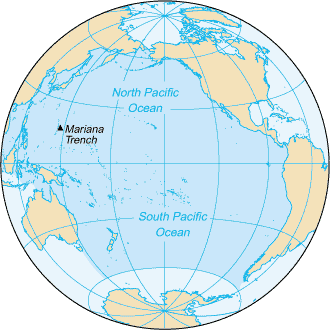
It’s a challenge to visualize the true scale of our planet’s largest feature. If you could gather all of Earth's continents and islands—from the vastness of Asia to the smallest atoll—and place them together, they would all fit inside the Pacific Ocean with room to spare. This single body of water covers roughly a third of the globe's surface. Its sheer size means that the most remote point on Earth, known as Point Nemo, is located within its waters. At this spot, you are farther from any land than the astronauts on the International Space Station are from the surface of the Earth below them.
This immense basin is a direct result of plate tectonics. The Pacific Ocean sits atop the Earth's largest tectonic plate, the Pacific Plate, which is slowly being subducted, or forced under, the surrounding continental plates. This process has created the deepest parts of our world, like the Mariana Trench, and fuels the intense volcanic and seismic activity of the "Ring of Fire" that lines its edges. Ironically, this often-turbulent ocean was named "Mar Pacífico," or "peaceful sea," by the explorer Ferdinand (Review) Magellan in 1521, who was fortunate enough to experience unusually calm waters during his historic circumnavigation of the globe.