19
Substitution Cipher Puzzle
Encrypted text
OM KINJ WKMZM WDFWKZ WI YM ZMNG MEVJMHW WKQW QNN SMH QDM RDMQWMJ MXFQN
 Cryptograms Café
Encrypted text
OM KINJ WKMZM WDFWKZ WI YM ZMNG MEVJMHW WKQW QNN SMH QDM RDMQWMJ MXFQN
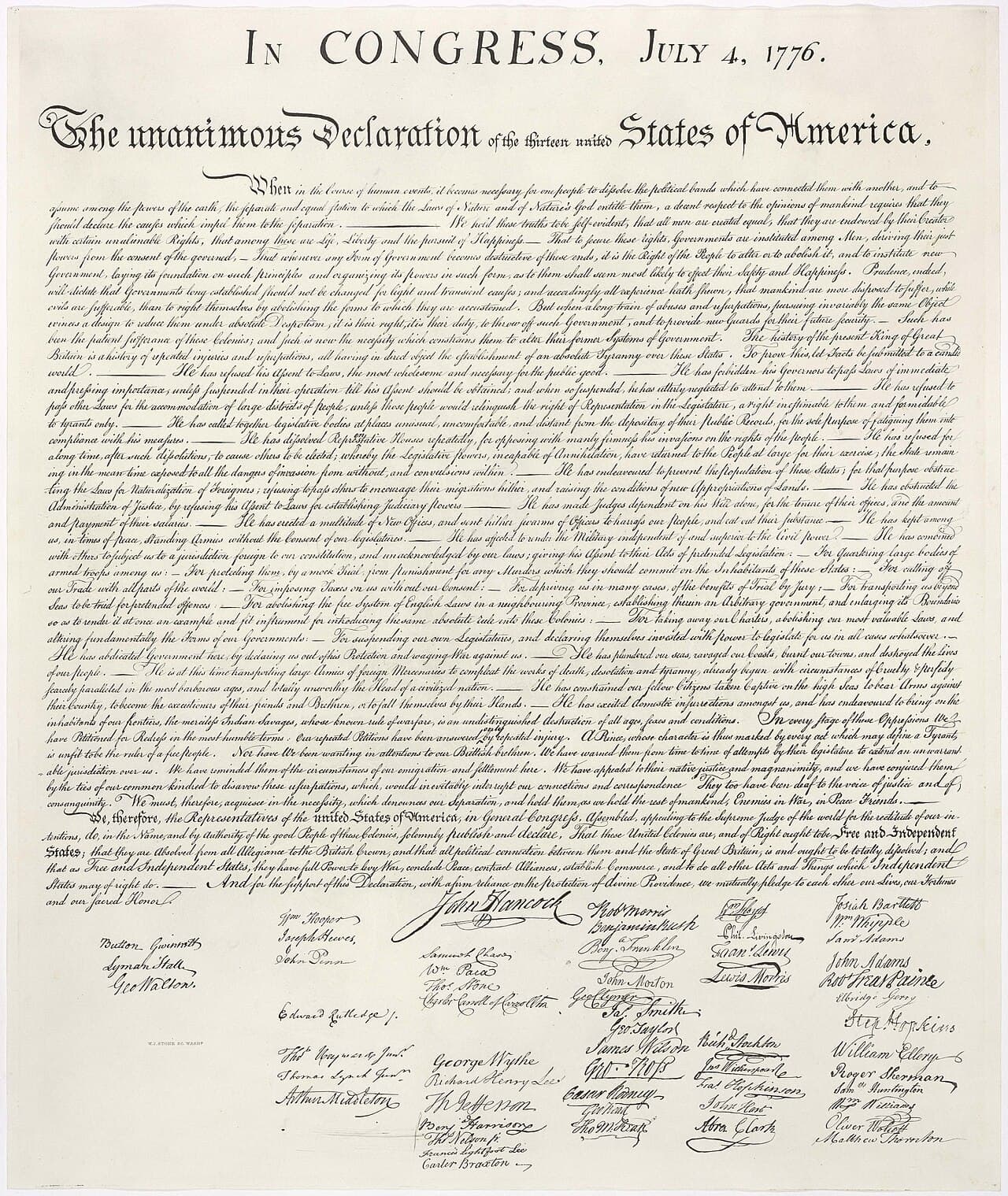
The phrase you've decoded, "We hold these truths to be self-evident, that all men are created equal," is one of the most powerful and enduring statements in American history. It is the second sentence of the United States Declaration of Independence, adopted on July 4, 1776, and encapsulates the foundational ideals of the nation. The concept of "self-evident truths" means these principles are considered obviously true and require no proof, asserting that all individuals are born with inherent equality and unalienable rights, including "Life, Liberty and the pursuit of Happiness." These ideas were heavily influenced by Enlightenment philosophers like John Locke, who articulated the inherent equality and individual liberty of all people.
The primary author of the Declaration of Independence was Thomas Jefferson, who drafted the document between June 11 and June 28, 1776, while serving as a delegate to the Second Continental Congress. At just 33 years old, Jefferson was already a renowned writer and was chosen for the task by a Committee of Five, which included John Adams and Benjamin Franklin. While Jefferson's draft underwent some changes by Congress, more than 75 percent of his original text remained. A true polymath, Jefferson had diverse talents in writing, economics, and philosophy, and later became the third President of the United States. Despite penning these words championing equality, Jefferson was a slave owner, a complex aspect of his legacy that highlights the contradictions of the era.
This puzzle utilizes a substitution cipher, a fundamental method in cryptography where each letter in the plaintext is systematically replaced with a different letter or symbol to create ciphertext. The history of such ciphers dates back thousands of years, with early examples found in ancient Egypt and Mesopotamia. One of the most famous historical substitution ciphers is the Caesar cipher, used by Julius Caesar in the 1st century BC to protect military communications. This simple method involved shifting each letter a fixed number of places down the alphabet, a technique that laid groundwork for more complex cryptographic systems used throughout history to secure sensitive information.
Encrypted text
YJYNA FJB RWENWCNM RW JWLRNWC LQRWJ
Encrypted text
HCF NAVUPKER MB QKXU UVF UPMIQ HCF RFTFI JMIEFVR MB HCF UIZKFIH JMVOE
Encrypted text
GMIMHAC TBUJXNTK HXNSR FYTNMVF VTHSPNMTC QTOXNT VXJPYQPC
Encrypted text
Eob xvna eozvm gb ousb ex kbuc zi kbuc zeibnk.
Encrypted text
TCM PJIDMJT BOMMFQ DJVMJTMS SMHKIOPIY
Encrypted text
SCL RULZ MTJTH KNLJLP DJ LDBCSLLJ RDXSY JDJL