
10
Learn More
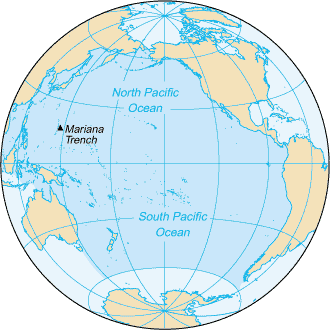
The vast expanse of water that covers nearly one-third of our planet's surface is the Pacific Ocean, making it the largest ocean on Earth. This immense body of water is so grand that its area, approximately 165.25 million square kilometers (63.8 million square miles), is greater than all of the Earth's landmasses combined. It also contains more than half of the world's oceanic water, holding roughly twice the volume of the Atlantic Ocean, the next largest. The ocean received its name "Mar Pacifico," meaning "peaceful sea," from explorer Ferdinand Magellan in 1520, who encountered calm waters during his voyage.
Beyond its sheer size, the Pacific is also the deepest ocean, with an average depth of about 4,000 meters (13,000 feet). Its most profound point is the Challenger Deep, located within the Mariana Trench in the western Pacific, plunging to an astonishing depth of over 10,984 meters (36,037 feet). To put this into perspective, Mount Everest, the world's tallest mountain, would be completely submerged if placed at the bottom of the Challenger Deep. This colossal ocean is also famously home to the "Ring of Fire," a horseshoe-shaped belt around its basin that hosts over 75% of the world's volcanoes and is responsible for about 90% of global earthquakes.
The Pacific Ocean is dotted with an incredible number of islands, estimated to be between 25,000 and 30,000, far more than any other ocean. These islands vary greatly, from volcanic formations to low-lying coral (Deals) atolls. Interestingly, despite its immense size, the Pacific Ocean is actually shrinking by about one inch (2.5 centimeters) per year due to the continuous movement of tectonic plates. This dynamic and vast body of water plays a critical role in regulating global climate and weather patterns, influencing life across the entire planet.
More General Trivia Questions
20
Which beverage was named after its resemblance to the dark brown clothing warn by 16th century Italian monks?
19In the ancient Mediterranean world there was no soap. An item normally found in the kitchen was also used for washing the body. What was it?
18What kind of baked pudding containing apples, raisins, and spices is named for a dark woman?
18What do we call the food item consisting of toast, ham, poached eggs, and hollandaise sauce?
18Churchills, Coronas, Lonsdales, and Torpedos are examples of what consumable products?
18Which vegetable grows best in Idaho, Washington, Maine, and Wisconsin?