
3
Learn More
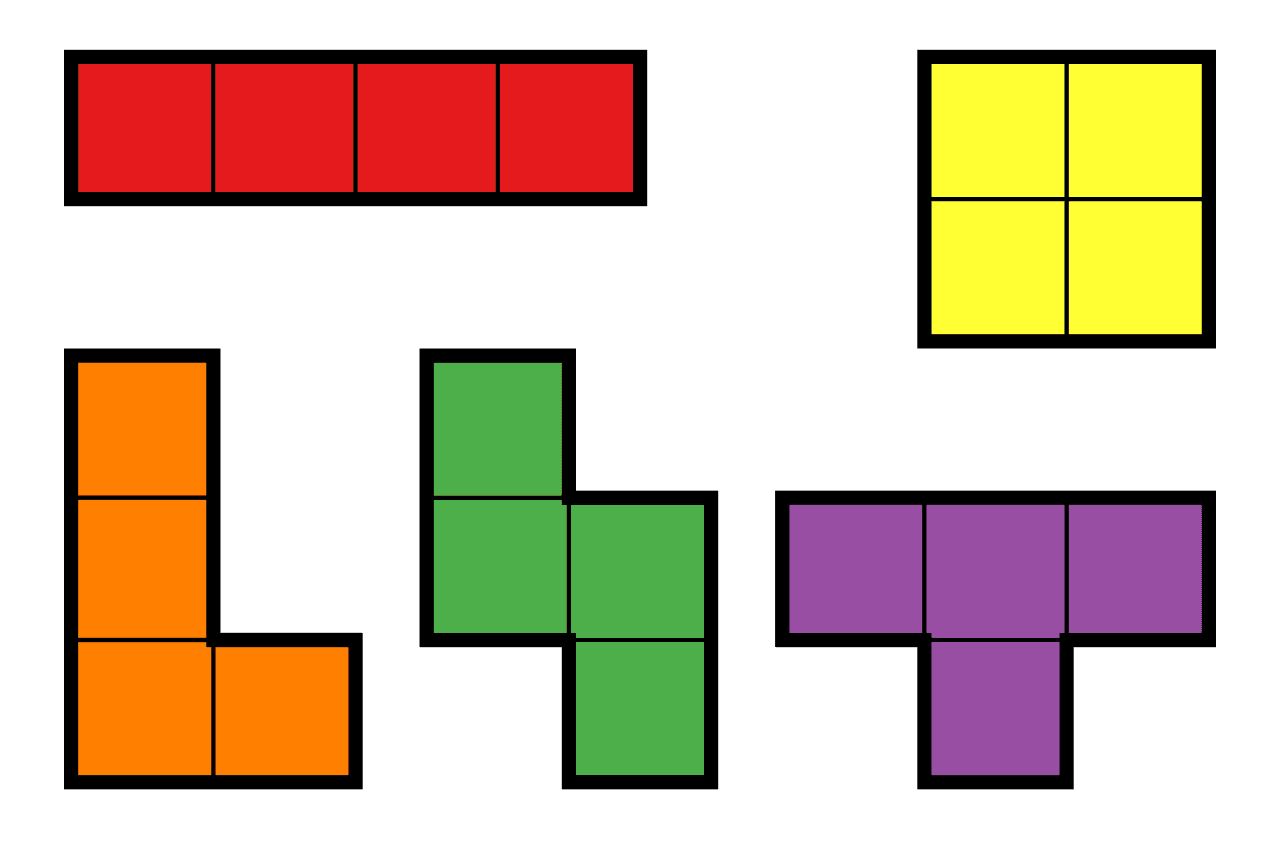
The iconic falling blocks in the game "Tetris" are known as tetrominoes, a mathematical term for a polyomino made of four connected squares. While there are different ways to classify polyominoes, "Tetris" specifically uses the seven distinct "one-sided" tetrominoes. These are shapes that can be rotated but not flipped over, which is crucial for gameplay. The game's creator, Alexey Pajitnov, was inspired by a puzzle game using "pentominoes," which are shapes made of five squares. He decided to simplify the concept to four-square pieces, finding the twelve possible pentomino shapes too complex for his game.
The seven unique tetrominoes are often identified by letters of the alphabet they resemble: I (a straight line), O (a square), T (a T-shape), J (a reverse L-shape), L (an L-shape), S (a Z-like shape), and Z (a reverse S-like shape). The I, O, and T pieces possess reflectional symmetry, meaning they look the same even if mirrored. However, the J, L, S, and Z pieces exhibit chirality; the J and L are mirror images of each other, as are the S and Z. This distinction means that in the game, you can rotate an L-piece, but you cannot flip it to become a J-piece.
The name "Tetris" itself is a clever combination derived from "tetromino" and "tennis," which was Pajitnov's favorite sport. Created in 1985 by the Soviet software engineer, the game's simple yet profound concept of fitting these seven shapes together to clear lines quickly captivated players worldwide. It has since become one of the best-selling video game series in history, a testament to the enduring appeal of these fundamental geometric forms.
More Games Trivia Questions
22
What are the name of the cartoon-like interludes that interrupt videogame play to narrate the story?
21What is the name of the peripheral device that can be plugged into a Nintendo 64 controller to make it vibrate?
21Which movie did Dwayne "the Rock" Johnson star in that was based on a videogame?
19Pokémon was originally released on which videogame console?
19What color do the ghost enemies turn to once Pac-Man eats a Power Pellet?
19What weapon was so powerful that Epic Games pulled it from "Fortnite" after only four days in December 2018?