

The Mathematics Behind Sudoku
At first glance, a Sudoku puzzle is a simple grid, a calming pastime found in newspapers and puzzle books. It presents a straightforward challenge: fill a 9x9 grid so that each row, column, and 3x3 subgrid contains all of the digits from 1 to 9. It feels like a game of pure logic, a test of patience and pattern recognition. Yet, beneath this tranquil surface lies a deep and intricate world of mathematics, a symphony of combinatorics, graph theory, and computational algorithms that dictates every aspect of the puzzle, from its creation to its solution.
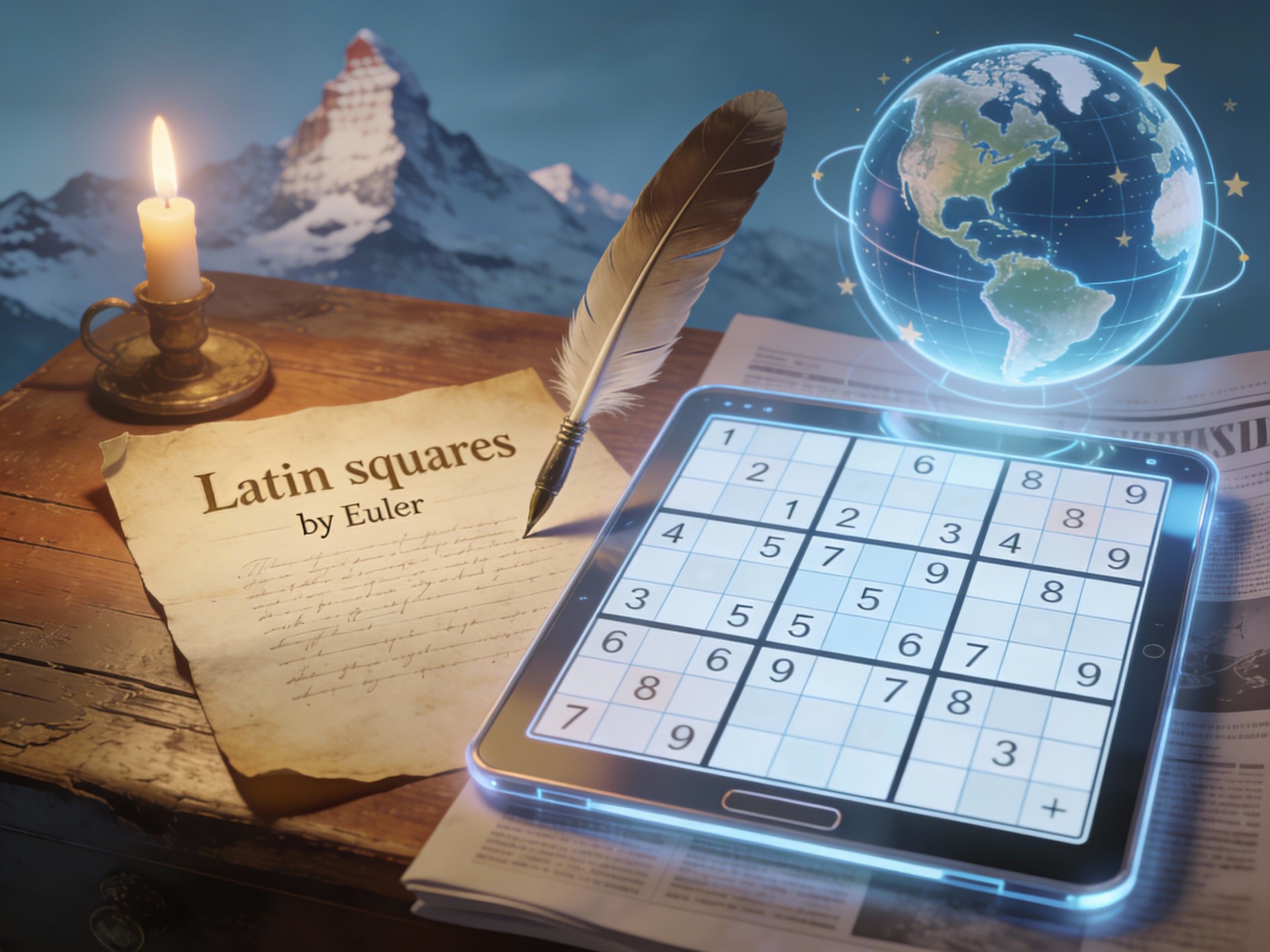
Many are surprised to learn that the puzzle's origins are not as ancient or Eastern as its name suggests. The journey of Sudoku is a global one, with Swiss DNA, an American upbringing, and a Japanese name. This journey begins not with a puzzle, but with a purely mathematical concept explored by the legendary 18th-century Swiss mathematician, Leonhard Euler. His work on "Latin Squares" laid the foundational principles for the game we know and love today.
From Euler's Squares to "Number Place": The Genesis of a Puzzle
The Abstract Beauty of Latin Squares
In 1783, Leonhard Euler was not thinking about creating a popular brain teaser; his mind was occupied with a combinatorial concept he dubbed "Latin Squares." A Latin square is an n x n grid filled with n different symbols, with the rule that each symbol appears exactly once in each row and each column. Sound familiar? This is the fundamental constraint that governs every Sudoku grid.
However, Euler's creation was a mathematical abstraction, a tool for research, not recreation. It lacked the crucial element that makes Sudoku so compelling: the 3x3 subgrids, or "boxes." This additional constraint transforms a simple Latin Square into the spatially complex puzzle that has captivated millions.
An American Architect's Ingenious Twist
For nearly two centuries, the Latin Square remained largely in the realm of mathematics. It wasn't until 1979 that the puzzle as we recognize it was born. Howard Garns, a retired architect from Indiana, had a passion for creating puzzles. He took Euler's Latin Square concept and introduced the brilliant spatial constraint of the 3x3 boxes.
In May 1979, Dell Pencil Puzzles and Word Games published Garns' invention under the name "Number Place." It gained a following among American puzzle enthusiasts but remained a relatively niche interest. Tragically, Garns passed away in 1989, never witnessing the global phenomenon his creation would become.
The name Sudoku is a Japanese abbreviation of "Sūji wa dokushin ni kagiru," which means "the digits must remain single." This name was coined by Maki Kaji, the president of the Japanese puzzle company Nikoli, who was instrumental in refining and popularizing the puzzle in Japan.
The Mind-Bending Numbers: Combinatorics of Sudoku
The rules of Sudoku may be simple, but the mathematical possibilities they generate are astronomical. The field of mathematics that deals with counting and arrangement, combinatorics, provides the tools to explore the sheer scale of the Sudoku universe.

How Many Sudoku Grids Exist?
One of the most fundamental questions mathematicians asked was: how many possible completed 9x9 Sudoku grids are there? The number is staggering. After extensive computational analysis, it was determined that there are exactly 6,670,903,752,021,072,936,960 validly filled grids.
This number, approximately 6.671 x 10²¹, was calculated by Bertram Felgenhauer and Frazer Jarvis in 2005. Their method involved a complex process of breaking down the problem, starting by assuming the top-left 3x3 block is in a standard configuration (1-9 in order) and then calculating the possible completions, finally multiplying by 9! (the number of ways to arrange the first block).
However, many of these grids are essentially the same. By applying symmetry operations—like swapping rows or columns within a block, transposing the grid, or relabeling the numbers—we can find "fundamentally different" grids. When all these symmetries are accounted for, the number of unique solutions drops to a more manageable, yet still immense, 5,472,730,538.
The Magic Number: What's the Minimum Number of Clues?
For a Sudoku to be considered a proper puzzle, it must have a single, unique solution. This raises a critical question: what is the minimum number of starting clues (or "givens") required to guarantee that uniqueness? For years, puzzle creators and mathematicians searched for puzzles with 16 clues, but none could be found.
It was long conjectured that the answer was 17. This was finally proven in 2014 by Gary McGuire, Bastian Tugemann, and Gilles Civario through an exhaustive computer search. They demonstrated that any puzzle with 16 or fewer clues will always have multiple solutions, making 17 the magic number for a valid Sudoku.
Quick Facts
- The general problem of solving n2xn2 Sudoku grids is known to be NP-complete, meaning the difficulty can grow exponentially with size.
- A completed Sudoku grid is a specific type of Latin Square.
- The sum of numbers in any completed row, column, or 3x3 box is always 45 (the sum of digits 1 through 9).
- The product of the numbers in any completed row, column, or box is 9! (factorial), which equals 362,880.
- While the minimum number of clues for a unique solution is 17, the maximum number of clues a minimal puzzle can have (where removing any one clue creates multiple solutions) is believed to be 40.
A Puzzle as a Graph: The Elegance of Graph Theory
One of the most powerful ways mathematicians analyze Sudoku is by transforming it into a different kind of structure: a graph. In graph theory, a graph is a collection of vertices (or nodes) connected by edges. This abstract representation unlocks a whole new set of tools for understanding the puzzle's logic.
Coloring the Grid
Imagine each of the 81 cells in a Sudoku grid as a vertex. An edge is drawn between any two vertices that are in the same row, same column, or same 3x3 box. This creates a "Sudoku graph." The rules of Sudoku now translate into a famous problem in graph theory: graph coloring.
The numbers 1 through 9 can be thought of as nine different "colors." The rule that no two connected vertices can have the same color is equivalent to the Sudoku rule that no number can be repeated in a row, column, or box. Solving a Sudoku puzzle is, therefore, mathematically equivalent to finding a proper 9-coloring of the Sudoku graph, given a partial pre-coloring from the initial clues.
The Logic of the Solve: Algorithms and Difficulty
How do we, or how does a computer, actually solve a Sudoku? The methods range from simple human logic to complex computational algorithms. Understanding these methods is key to understanding how puzzle difficulty is determined.

Human-Centric Techniques
When you solve a puzzle, you're using logical algorithms without even realizing it. Techniques like "scanning" for the only possible place a number can go in a box, or identifying "naked pairs" (when two cells in a group can only contain the same two numbers), are fundamental steps. More advanced strategies involve identifying complex patterns to eliminate possibilities.
The difficulty of a puzzle is often rated by the complexity of the logical techniques required to solve it. An "Easy" puzzle might only require basic scanning, while a "Fiendish" one may demand several advanced, multi-step deductions.
Computational Brute Force and Backtracking
For a computer, one of the most straightforward methods is a "brute-force" approach. A common version of this is called a backtracking algorithm. This algorithm works by placing a valid number (e.g., "1") in the first empty cell, moving to the next, and continuing until it hits a dead end—a cell where no number is valid.
When it gets stuck, it "backtracks" to the previous cell, erases its entry, and tries the next valid number. It then moves forward again. This depth-first search continues, systematically trying every possibility, until it finds a complete, valid solution. While inefficient for humans, this method is very effective for computers and is often used to verify that a puzzle has a unique solution.
Researchers have even developed a "Richter scale" for Sudoku difficulty. Mathematicians Maria Ercsey-Ravasz and Zoltán Toroczkai created an algorithm whose solving time correlated directly with human-perceived difficulty, allowing them to assign a numerical rating to any puzzle.
Conclusion: More Than Just a Game
So, the next time you pick up a Sudoku, remember the hidden world beneath its simple grid. You are not just filling in numbers; you are engaging with a structure born from 18th-century combinatorial theory, a puzzle that can be described with the elegant language of graph theory, and a challenge whose solution space is so vast it defies human imagination.
The journey from Euler's abstract Latin Squares to the daily newspaper puzzle is a testament to the unexpected ways in which pure mathematics can manifest in our everyday lives. It's a quiet symphony of logic and numbers, a beautiful intersection of human intuition and profound mathematical principles, waiting to be conducted one cell at a time.