
13
Learn More
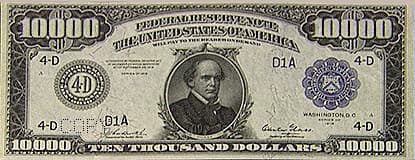
The highest denomination of United States paper money ever printed for public circulation was the $10,000 bill. While a $100,000 Gold Certificate was also produced, it was strictly for official transactions between Federal Reserve Banks and never circulated among the general public. The last of these large denominations, including the $500, $1,000, $5,000, and $10,000 bills, were printed in 1945 and officially discontinued by the Federal Reserve System on July 14, 1969.
These high-denomination notes served a practical purpose in their time. Before the advent of modern electronic banking and sophisticated wire transfer systems, they were primarily used for large-scale transactions between banks and financial institutions. The $10,000 bill prominently featured the portrait of Salmon P. Chase, who served as Abraham Lincoln's Secretary of the Treasury and later as Chief Justice of the United States.
Although these large bills are no longer printed or distributed, they remain legal tender in the United States, meaning they could technically still be used at their face value. However, due to their rarity and historical significance, surviving examples are worth considerably more to collectors than their printed denomination. The decision to discontinue them was largely attributed to a lack of public use and, in later years, to efforts aimed at combating organized crime by making it harder to transport large sums of illicit money.
More Other Trivia Questions
20
What is the name of the grand prize given at the Cannes film festival?
20What is the name of the five-dice game where players try to create different combinations similar to poker hands?
20A number of years ago, what product was advertised by means of the slogan, "I can't believe I ate the whole thing" ?
20How long is one lap of the Indianapolis motor speedway?
20Most people have 20 of these, but in 1921 a boy born in England had 29 of them. What were they?
20The Wright brothers successfully flew an airplane in 1903 in what North Carolina location?