

Bizarre Historical Events That Actually Happened
History isn't always about stoic figures and monumental decisions. Sometimes, it's about the downright weird, the comically absurd, and the tragically bizarre. Peel back the layers of well-trodden historical accounts, and you'll find moments so strange they sound like they were plucked from a fever dream. Yet, these events are meticulously documented, serving as a peculiar reminder that the past was just as unpredictable and chaotic as the present.
From military campaigns against flightless birds to an entire city gripped by a literal dance fever, we're about to journey through some of the most bewildering, confounding, and utterly bizarre events that have ever actually happened. Prepare to have your perception of history delightfully warped.
The Great Emu War of 1932: Australia vs. Birds
In the annals of military history, few conflicts are as baffling as the one that pitted the might of the Australian army against a foe of the feathered variety. In 1932, in the Campion district of Western Australia, the opponent was not a foreign power, but a population of around 20,000 emus.
A Fowl Situation
The stage for this peculiar conflict was set after World War I, when the Australian government granted land to discharged veterans to cultivate wheat. These new farmers, already struggling with the harsh realities of the Great Depression and unfulfilled promises of government subsidies, soon faced a new plague: a massive migration of emus. The large, flightless birds, in their search for food and water, descended upon the farmlands, trampling crops and tearing down fences, which in turn allowed rabbits to cause even more damage.
Desperate, the ex-soldier farmers, who were well aware of the effectiveness of machine guns, sent a deputation to the Minister of Defence, Sir George Pearce, requesting military intervention. In a decision that would soon become infamous, Pearce agreed, authorizing a military operation to cull the destructive birds.
The "War" Begins
In November 1932, Major G.P.W. Meredith of the Royal Australian Artillery, along with two soldiers armed with two Lewis light machine guns and 10,000 rounds of ammunition, was dispatched to the front lines. They expected a swift and decisive victory. The emus, however, had other ideas.
The first engagement on November 2 proved utterly ineffective. The emus were out of range, and when locals tried to herd them into an ambush, the birds cleverly split into small groups and scattered, making them impossible targets. A few days later, on November 4, Major Meredith set up an ambush near a dam where over 1,000 emus were spotted. Just as they opened fire, one of the guns jammed after only a dozen birds were killed, and the rest vanished before another shot could be fired.
Major Meredith was quoted as saying, "If we had a military division with the bullet-carrying capacity of these birds, it would face any army in the world. They can face machine guns with the invulnerability of tanks."
Attempts to mount a machine gun on a truck were also thwarted; the emus simply outran the vehicle on the rough terrain. After nearly a month of humiliating failures and negative press coverage that ridiculed the "Emu War," the operation was called off. The official report claimed 986 emus were killed, using 9,860 rounds of ammunition—a ratio of exactly 10 bullets per confirmed kill. The emus, for all intents and purposes, had won.
The Dancing Plague of 1518: A Deadly Dance-Off
Imagine an urge to dance so powerful it overrides every other instinct—the need for rest, for food, for self-preservation. In the summer of 1518, this wasn't a hypothetical scenario; it was a terrifying reality for the citizens of Strasbourg, a city in the Holy Roman Empire (modern-day France).
The First Dancer
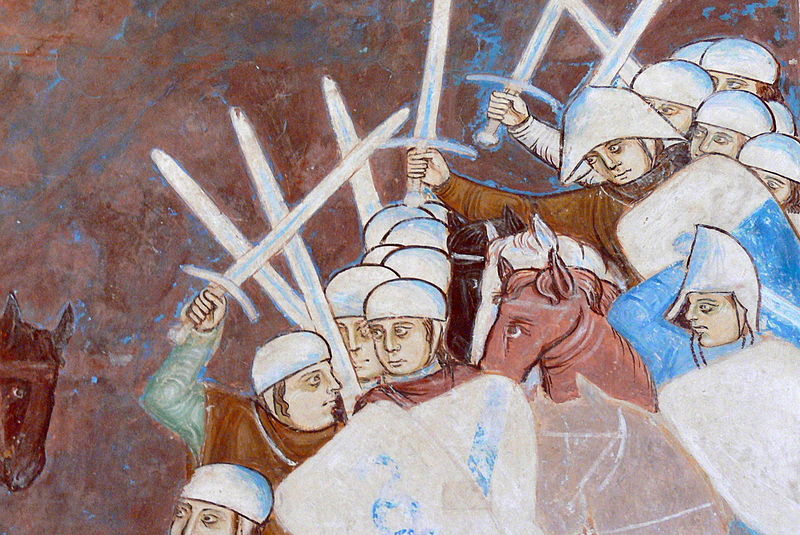
It all began in July with a single woman, known as Frau Troffea. She stepped into a narrow street and began to dance fervently, without music or celebration. Her husband pleaded with her to stop, but she couldn't. She danced for hours until she collapsed from exhaustion, only to resume her frantic movements after a short rest. This solo performance continued for nearly a week.
Soon, a deeply unsettling phenomenon occurred: others began to join her. Within a week, over 30 people were caught in the same compulsive dance. By August, the number of dancers had swelled to an astonishing 400. These were not joyful revelers; historical accounts describe people screaming in pain and begging for mercy as their bodies jerked and twirled against their will.
A Baffling Response
The city's authorities were perplexed. Consulting with local physicians, they dismissed supernatural causes and diagnosed the affliction as "hot blood." Their prescribed cure was, astonishingly, more dancing. The theory was that the afflicted must dance the fever out of their systems.
To facilitate this bizarre treatment, the council cleared guildhalls and open-air markets, and even constructed a wooden stage. They hired professional dancers to keep the afflicted moving and musicians to provide a constant beat. This strategy backfired spectacularly. The public spectacle only exacerbated the contagion, and more citizens were drawn into the manic dancing.
The toll of this relentless activity was grim. Many dancers collapsed, and a number of them died from sheer exhaustion, strokes, and heart attacks.
The strange and deadly episode only began to subside in early September when the authorities changed tactics. The remaining dancers were taken to a mountaintop shrine dedicated to St. Vitus, a saint believed to have the power to inflict a dancing curse, to pray for absolution.
What Caused the Mania?
Modern historians and scientists have several theories, though none are definitive:
- Mass Psychogenic Illness (MPI): The most widely accepted theory is that it was a case of mass hysteria. The region had been suffering from extreme hardship, including famine, poverty, and diseases like smallpox and syphilis. This immense psychological stress may have manifested as a physical affliction, fueled by a shared superstitious belief in the power of St. Vitus to cause such a plague.
- Ergot Poisoning: Some have suggested the dancers accidentally ingested ergot, a toxic mold that grows on damp rye. This fungus can cause convulsions, spasms, and hallucinations. However, many experts doubt this, as ergot poisoning typically hinders coordinated movement, making sustained dancing unlikely.
The Tanganyika Laughter Epidemic of 1962
Laughter is usually a sign of joy, but in 1962, in what was then Tanganyika (now Tanzania), it became the primary symptom of a bizarre epidemic that paralyzed communities for months. This event serves as one of the most well-documented cases of mass psychogenic illness in modern history.
It Started with a Joke
The phenomenon began on January 30, 1962, at a mission-run boarding school for girls in the village of Kashasha. It started innocently enough with three students who began laughing, possibly at a joke. But their laughter didn't stop. It grew uncontrollable, spreading like a virus throughout the school.
Within weeks, 95 of the school's 159 pupils, aged 12 to 18, were affected. The symptoms were far from amusing. The girls experienced recurring attacks of laughing and crying that could last from a few hours up to 16 days. These fits were often accompanied by restlessness, pain, fainting, respiratory problems, and rashes. The teaching staff, who remained unaffected, reported that the students were unable to concentrate, forcing the school to shut down on March 18.
A Contagion of Hysteria
Closing the school did not end the epidemic; it only spread it further. When the students were sent home to their respective villages, the "laughing sickness" traveled with them.
- The epidemic spread to the nearby village of Nshamba, where 217 people, mostly young adults, were afflicted in April and May.
- In June, it reached the Ramashenye girls' middle school, affecting another 48 students.
The phenomenon was not a constant, uninterrupted fit of laughter for months on end. Rather, it occurred in waves, with individuals suffering from recurring attacks. In total, the epidemic lasted for an astonishing 18 months, leading to the temporary closure of 14 schools and affecting approximately 1,000 people.
The Science Behind the Laughter
Medical investigations found no evidence of toxins, viruses, or any underlying physical illness that could explain the symptoms. The accepted explanation is that the Tanganyika Laughter Epidemic was a classic case of Mass Psychogenic Illness (MPI), also known as mass hysteria.
Christian F. Hempelmann, a professor who has studied the event, theorized that the episode was stress-induced. Tanganyika had just gained its independence in 1961, and students reported feeling immense pressure and anxiety from the higher expectations of their parents and teachers in a rapidly changing society.
MPI often occurs in groups of people under significant, shared stress who have little power or agency. The laughter, while appearing bizarre, was an outward physical manifestation of a deep-seated collective anxiety. The epidemic eventually died out on its own as stress levels subsided and the communities moved forward.
Quick Facts
- The original oaken bucket from the 1325 war is still on display in Modena, Italy—though it's a replica; the original is kept in the Town Hall.
- During the Great Emu War, one soldier noted the emus seemed to have organized military tactics, with each group having a "lookout" bird to warn the others of danger.
- The Dancing Plague of 1518 was not an isolated incident; several other, smaller outbreaks of "dancing mania" were recorded in Europe between the 10th and 16th centuries.
- No teachers or staff at the Kashasha school were affected by the 1962 laughter epidemic, only the students.
The War of the Oaken Bucket: A Medieval Feud
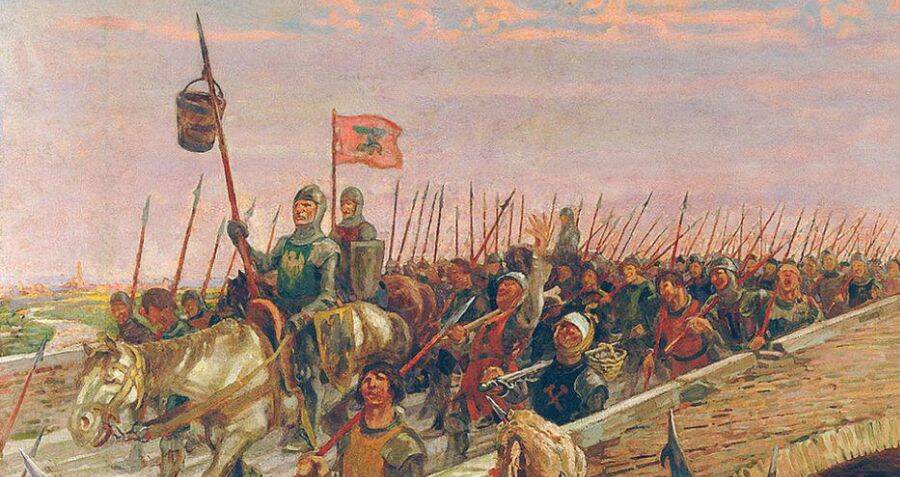
While many wars are fought over land, resources, or ideology, the conflict between the rival Italian city-states of Modena and Bologna in 1325 has been immortalized by a far more trivial object: a simple wooden bucket. While the bucket wasn't the true cause of the war, its story perfectly captures the absurdity of the long-running feud.
A Rivalry Centuries in the Making
The backdrop for this conflict was the bitter, centuries-long struggle between the Guelphs and the Ghibellines. This was a factional strife that divided northern Italy, with the Guelphs (including Bologna) supporting the Pope and the Ghibellines (including Modena) backing the Holy Roman Emperor. This political divide fueled constant animosity and frequent border skirmishes over territory.
Tensions had been escalating for decades. In 1296, Bologna had seized several castles from Modena, an act sanctioned by the Pope. In the months leading up to the war in 1325, raids intensified, with both sides burning fields and plundering the other's territory. The final straw came when Modena captured the strategic Bolognese fortress of Monteveglio. Humiliated, Bologna declared war.
The Battle of Zappolino
Bologna, a Guelph stronghold, amassed a formidable army of about 30,000 infantry and 2,000 cavalry. In November 1325, this massive force marched on Modena. The Ghibelline Modenese were vastly outnumbered, fielding an army of only 5,000 infantry and 2,000 cavalry.
The two armies met on November 15, 1325, at the Battle of Zappolino. In what is considered one of the largest battles of the European Middle Ages, the smaller, more disciplined Modenese army achieved a shocking victory. In a fierce battle that lasted only a couple of hours, the Bolognese forces were completely routed and fled back toward their city walls.
The aftermath was bloody, with around 2,000 men killed in total. The victorious Modenese pursued the fleeing army to the very gates of Bologna, not to lay siege, but to humiliate them further by destroying several castles along the way.
The Legend of the Bucket
So, where does the bucket come in? The popular legend, cemented by Alessandro Tassoni's 17th-century mock-heroic poem "La Secchia Rapita" ("The Stolen Bucket"), claims the war started when Modenese soldiers snuck into Bologna and stole a bucket from a city well.
However, historical accounts indicate the bucket was actually taken as a trophy after the Battle of Zappolino. To add insult to injury, the victorious Modenese soldiers grabbed an oaken bucket from a well just outside Bologna's city gates as a spoil of war. They took it back to Modena, where it was hung in the bell tower of the cathedral as a symbol of their improbable victory.
Conclusion: The Strange Fabric of the Past
From the dusty battlefields of the Australian outback to the cobblestone streets of medieval Europe, history is woven with threads of the utterly inexplicable. The Great Emu War, the Dancing Plague, the Laughter Epidemic, and the War of the Oaken Bucket are more than just historical footnotes or amusing trivia. They are vivid windows into the anxieties, beliefs, and sheer unpredictability of human societies.
These events challenge our neat and tidy understanding of the past. They remind us that history is not just a sequence of logical events but a chaotic, and often bizarre, tapestry of human experience. The next time you think of history as a dry collection of dates and names, remember the soldiers who lost a war to birds and the city that tried to cure a plague with a dance party. The past, it turns out, is far stranger than we could ever imagine.