

Famous Last Words Throughout History
What is it about the final words of the dying that so captivates the living? Is it the hope for a glimpse of wisdom, a flash of wit, or a profound summary of a life lived? These parting statements, whether carefully prepared or uttered in a fleeting moment, have the power to echo through history, offering a final, indelible impression of the person behind the legend. From the battlefield to the deathbed, the gallows to the quiet of a private room, these last words range from the deeply poignant to the shockingly irreverent, each a tiny, self-contained story at the very end of the grand narrative.

For centuries, we have collected and repeated these final phrases, sometimes embellishing them to better fit the persona of the speaker. They remind us that for all the pomp and circumstance of history, it is ultimately a story of individuals, each with a final thought to share. Join us as we explore some of the most famous, curious, and impactful last words ever spoken, and what they reveal about the lives they concluded.
The Wittiest of Farewells: Humor in the Face of the End
Some individuals face the final curtain not with fear or solemnity, but with a final, defiant quip. Their last words serve as a testament to a life lived with a sharp mind and a keen sense of humor, proving that even in death, there's room for one last laugh.
Oscar Wilde's Duel with the Wallpaper
The Irish playwright and poet Oscar Wilde was as famous for his flamboyant style and razor-sharp wit as he was for his literary works. Even in his final days, living in a state of destitution in a Parisian hotel in November 1900, his humor did not desert him. He is famously quoted as saying:
"My wallpaper and I are fighting a duel to the death. One or the other of us has to go."
While he did make this remark, expressing his disdain for his drab surroundings, it was likely uttered a few weeks before his actual death from meningitis. The quote, however, has become eternally linked with his passing, perfectly encapsulating the spirit of a man who found humor even in the bleakest of circumstances.
Voltaire's Final Negotiation
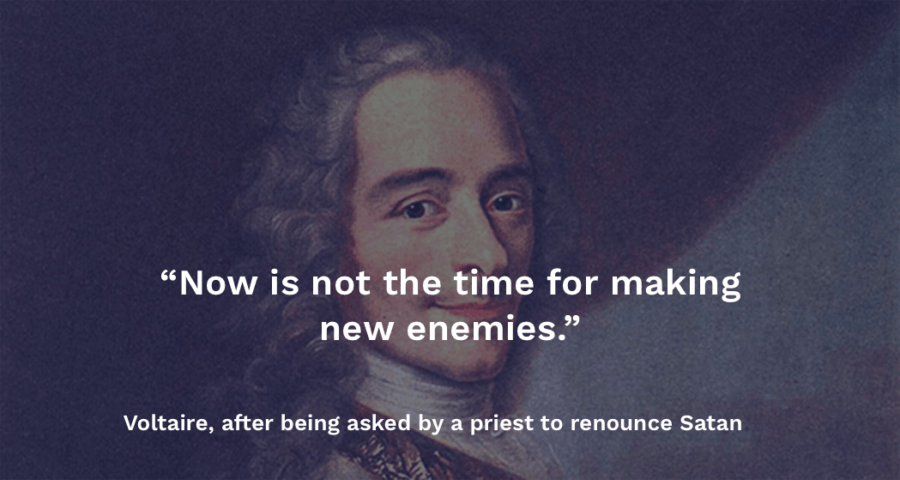
The French Enlightenment writer and philosopher Voltaire was a lifelong critic of the established church. As he lay dying in 1778, a priest at his bedside asked him to renounce Satan. True to form, Voltaire's response was both witty and strategic:
"Now is not the time for making new enemies."
This final remark demonstrates the quick thinking and satirical edge that defined his life's work. Even at the threshold of death, he couldn't resist a clever jab at religious formalities.
Defiance and Conviction: Last Words from the Condemned
For those facing execution, their last words often become a final act of defiance, a proclamation of innocence, or a reaffirmation of their beliefs. These statements, delivered from the gallows, the firing squad, or the electric chair, are charged with the weight of their circumstances.
Che Guevara's Challenge
On October 8, 1967, the Marxist revolutionary leader Ernesto "Che" Guevara was captured by U.S.-trained Bolivian soldiers. The following day, as the soldier ordered to execute him hesitated, Guevara reportedly spoke with unflinching bravery:
"I know you've come to kill me. Shoot, you are only going to kill a man."
These words cemented his legacy as a fearless revolutionary, facing his end with a powerful statement about the resilience of his ideals beyond his own mortality.
The Anarchist's Exclamation
George Engel, one of the men convicted for his role in the 1886 Haymarket Affair in Chicago, met his end by hanging on November 11, 1887. His final words, shouted in German, were a ringing endorsement of his political beliefs:
"Hurrah for anarchy! This is the happiest moment of my life!"
His statement was not one of remorse, but of ultimate, unwavering commitment to his cause, a final, defiant cry against the state that condemned him.
Quick Facts
- George Appel, executed by electric chair in 1928 for murder, quipped, "Well folks, you'll soon see a baked apple."
- Murderer James W. Rodgers, when asked for a last request before facing a firing squad, reportedly said, "Bring me a bullet-proof vest."
- The last words of serial killer Aileen Wuornos were, "I'd just like to say I'm sailing with the Rock and I'll be back like 'Independence Day' with Jesus. June 6, like the movie, big mother ship and all. I'll be back."
- Robert Alton Harris, before his execution, misquoted the film Bill & Ted's Bogus Journey, saying, "You can be a king or a street sweeper, but everybody dances with the grim reaper."
Poetic and Profound: Final Musings from Great Minds
The last words of great thinkers, writers, and artists are often scrutinized for a final pearl of wisdom. Sometimes, their parting phrases are as beautiful and thought-provoking as the works they left behind.
The Humility of a Genius: Leonardo da Vinci
Leonardo da Vinci, the quintessential Renaissance man, was a master of art, science, and invention. Yet, on his deathbed in 1519, he is said to have expressed a profound sense of humility. His reported last words were:
"I have offended God and mankind because my work did not reach the quality it should have."
While the authenticity of this quote is debated by historians, with some suggesting it was an invention of his biographer Giorgio Vasari, it speaks to the relentless perfectionism of a man who, even at the end of his life, felt he had not done enough. For one of history's greatest geniuses to feel this way is a humbling thought in itself.
Emily Dickinson's Final Metaphor
The reclusive American poet Emily Dickinson lived a life rich in internal reflection, which she poured into her unconventional poetry. Her last words, spoken in May 1886, were as enigmatic and poetic as her verses:
"I must go in; the fog is rising."
This simple, metaphorical phrase is a fitting end for a writer who saw the profound in the everyday and used the imagery of nature to explore the great mysteries of life and death.
Sir Isaac Newton on the Shores of Truth
Sir Isaac Newton, who revolutionized our understanding of physics and the universe, viewed his own monumental achievements with remarkable modesty. Shortly before his death in 1727, he reflected on his life's work:
"I don't know what I may seem to a the world. But as to myself I seem to have been only like a boy playing on the seashore and diverting myself now and then in finding a smoother pebble or a prettier shell than the ordinary, whilst the great ocean of truth lay all undiscovered before me."
These words offer a beautiful and poignant perspective on the vastness of knowledge and the humility of a true intellectual giant.
The Irony of Fate: When Last Words Go Wrong
History is filled with moments of profound irony, and last words are no exception. Some final statements are remembered not for their wisdom, but for being tragically, and sometimes comically, incorrect.

John Adams and Thomas Jefferson
John Adams, the second President of the United States, died on July 4, 1826, the 50th anniversary of the Declaration of Independence. His last words were a tribute to his long-time rival and friend, Thomas Jefferson:
"Thomas Jefferson survives."
In a twist of historical fate, Adams was mistaken. Jefferson had died just a few hours earlier at his home in Virginia, a fact Adams could not have known. This poignant error forever linked the two founding fathers in death as they were in life.
Nostradamus's Final Prediction
The 16th-century French astrologer and physician Michel de Nostredame, better known as Nostradamus, made a life's work of predicting the future. It is perhaps fitting, then, that his final act was to accurately predict his own demise. On the evening of July 1, 1566, he allegedly told his secretary:
"You will not find me alive at sunrise."
He was, of course, correct. He was found dead the next morning, making his last words a successful, albeit somber, final prophecy.
The Quiet and the Simple: Unadorned Farewells
Not all last words are grand pronouncements. Many are simple, quiet, and deeply personal, reflecting a final, human moment rather than a performance for posterity.
Marie Antoinette's Apology
On October 16, 1793, Marie Antoinette, the last Queen of France, was led to the guillotine. Stripped of her royal status and finery, she faced a jeering crowd. As she ascended the scaffold, she accidentally stepped on her executioner's foot. Her final words were not of defiance or sorrow, but of simple courtesy:
"Pardon me, sir. I did not mean to do it."
This small act of politeness in the face of a brutal end has become one of history's most remembered last words, a poignant glimpse of the person behind the vilified queen.
Bob Marley's Wisdom
The reggae superstar Bob Marley died of cancer in 1981 at the age of 36. His music often touched on themes of love, peace, and the corrupting influence of materialism. His last words, spoken to his son Ziggy, were a simple and powerful distillation of his life's philosophy:
"Money can't buy life."
This final piece of fatherly advice serves as a fitting epitaph for a man who inspired millions with his message of spiritual wealth over material gain.
The Controversial and Contradictory
The historical record is often messy, and last words are no exception. Some famous final phrases are subjects of debate, their authenticity questioned or their meaning contested.
Karl Marx's Rejection of the Notion
The philosopher and revolutionary socialist Karl Marx reportedly had little patience for the tradition of last words. When his housekeeper asked him if he had any to impart before he died on March 14, 1883, he is said to have retorted:
"Go on, get out! Last words are for fools who haven't said enough!"
This brusque dismissal is perfectly in character for a man who spent his life writing voluminous critiques of society. In a way, by rejecting the idea of last words, he made a powerful final statement.
Mahatma Gandhi's Final Prayer
After being shot on January 30, 1948, it is widely believed that Mahatma Gandhi uttered the words "Hey, Ram" ("Oh, God"). However, this has been a matter of some dispute. Gandhi's former personal secretary once claimed he did not hear these words in the chaos that followed the shooting. Later, however, he clarified that he may simply not have heard them in the din, and testimony from the assassination trial supports the "Hey, Ram" account. This controversy highlights the difficulty of capturing a precise historical record in moments of trauma and confusion.
Conclusion: The Enduring Power of the Final Word
From the witty to the profound, the defiant to the humble, famous last words offer a unique window into the human experience. They remind us that history's grand figures were, in the end, just people, facing the same universal fate. Whether they met their end with a joke, a prayer, a curse, or a quiet observation, their final utterances have secured a unique place in our collective memory.
These words continue to fascinate us because they represent the ultimate deadline—the last chance to define oneself, to leave a final mark. As we've seen, these parting shots can be ironic, poignant, or fiercely in character, a final, fleeting summary of a life's story. They are the period at the end of a sentence, the closing of a book, and their echo continues to resonate long after the voice has been silenced.