

How Language Shapes the Way We Think
Does the Language You Speak Change Your Reality?
Imagine trying to describe a brilliant sunset without words for "red" or "orange." Or what if your language had no numbers, making it impossible to say you have three children or that your birthday is in two weeks? This might sound like a thought experiment, but for some cultures, it's a reality. It raises a mind-bending question: does the language we speak simply express our thoughts, or does it fundamentally shape them?
This very question is at the heart of a fascinating and long-debated idea in linguistics and psychology. For centuries, thinkers have pondered the intricate connection between our words and our minds. The prevailing modern view is that while language doesn't trap us in a cognitive box, it certainly nudges and guides our perceptions in surprising ways.
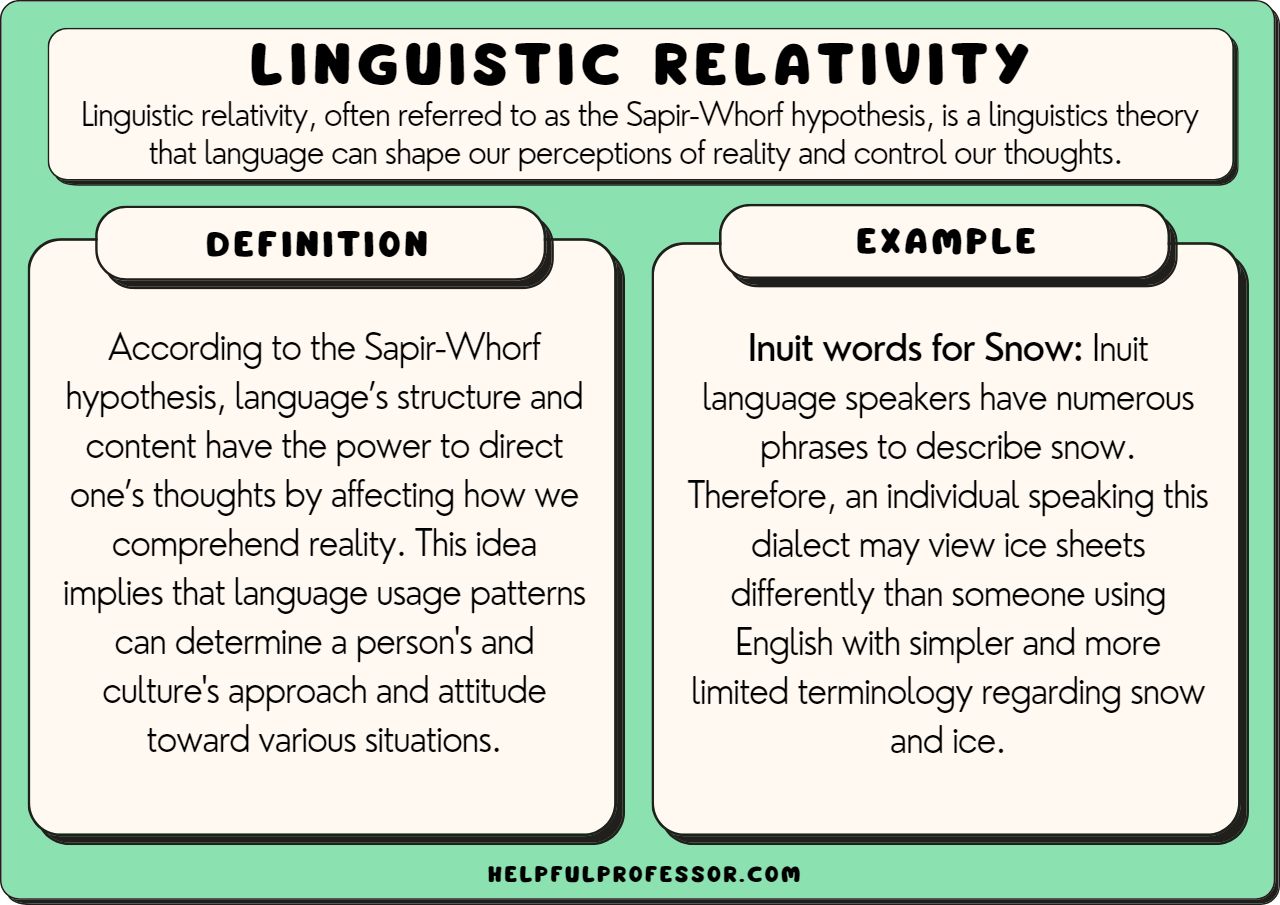
The core idea is known as the Sapir-Whorf hypothesis, or linguistic relativity. It proposes that the structure of a language affects its speakers' worldview and cognitive processes. In essence, people who speak different languages may think and perceive the world differently because of the linguistic tools at their disposal.
A Tale of Two Theories: Determinism vs. Relativity
The Sapir-Whorf hypothesis isn't a single, monolithic idea. It's more of a spectrum, with two main viewpoints: a "strong" version and a "weak" version.

Strong Version: Linguistic Determinism
The more extreme take is linguistic determinism. This view argues that language dictates thought. According to this perspective, if a language lacks a word for a particular concept, its speakers are essentially incapable of understanding that concept. For example, if a language had no past tense, its speakers would be unable to think about the past.
This strong version has been largely set aside by modern linguists. The consensus is that our cognitive abilities are not strictly imprisoned by our vocabulary or grammar. We can certainly think about things we don't have a specific word for.
Weak Version: Linguistic Relativity
The more accepted version is linguistic relativity. This theory suggests that language influences thought and perception, but doesn't completely control it. It shapes our habitual ways of thinking and directs our attention to certain aspects of reality over others. It's this version that has found compelling support in numerous studies across the globe.
Quick Facts
- The idea of linguistic relativity was pioneered by linguist-anthropologist Edward Sapir and his student Benjamin Whorf in the early 20th century.
- Whorf's research on the Hopi language of North America led him to believe that their concept of time was fundamentally different from that of English speakers, a claim that has been debated since.
- Cognitive scientist Lera Boroditsky is a leading contemporary researcher in this field, and her work has provided many modern examples of linguistic relativity.
- There are approximately 7,000 languages spoken in the world today, each offering a unique cognitive toolkit.
Seeing the World in Different Hues: Language and Color
One of the most compelling areas of research for linguistic relativity is color perception. While the human eye can perceive millions of colors, how we categorize and name them varies significantly across languages.
For instance, some languages, like that of the Dani people of New Guinea, have only two basic color terms: one for dark colors and one for light colors. In contrast, Russian has two distinct words for what English speakers call "blue": "goluboy" for light blue and "siniy" for dark blue.
Studies have shown that this linguistic distinction has a measurable effect on perception. Russian speakers are faster and more accurate at distinguishing between shades of light and dark blue than English speakers.
This suggests that having separate words for these colors makes the distinction more salient and easier to process. Similarly, Greek speakers, who also have two words for blue ("galazio" and "ble"), show a similar perceptual advantage. These findings indicate that language can fine-tune our visual experience, making us more sensitive to the distinctions that our vocabulary highlights.
Does Your Language Know Where You're Going? Space and Orientation
How do you give directions? You probably use terms like "left," "right," "in front of," and "behind." This is a relative frame of reference, as it depends on your own position. But not all languages rely on this egocentric system.

North, South, East, and West
Consider the Kuuk Thaayorre, an Aboriginal community in Australia. Their language doesn't use relative spatial terms. Instead, they exclusively use cardinal directions: north, south, east, and west. A Kuuk Thaayorre speaker might say, "There's an ant on your southwest leg."
To speak this language, you must always know your orientation. As a result, speakers of such languages have a remarkable, almost superhuman sense of direction. This is a powerful example of how the daily demands of a language can train a specific cognitive ability.
Reading Direction and Mental Timelines
The direction in which we read and write also appears to influence our spatial thinking. Speakers of left-to-right languages, like English, tend to arrange events in a timeline that flows from left to right. Conversely, speakers of right-to-left languages, like Arabic or Hebrew, may arrange them from right to left.
It's About Time: How Language Shapes Our Experience of Time
Time is an abstract concept, and we often rely on spatial metaphors to talk about it. In English, we might talk about a "long" or "short" vacation, conceptualizing time as a distance. But in other languages, like Spanish and Greek, it's more common to talk about a "big" or "small" break, treating time as a volume.
This isn't just a quirk of speech; it affects how people estimate the passage of time. In one study, bilingual Spanish-Swedish speakers were asked to estimate how much time had passed while watching either a line growing (distance) or a container filling (volume). Their time estimates were influenced by the visual cue that matched the language they were prompted in. When prompted in Swedish, their estimates were swayed by the distance the line traveled. When prompted in Spanish, the fullness of the container held more sway.
As linguist Panos Athanasopoulos puts it, "By learning a new language, you suddenly become attuned to perceptual dimensions that you weren't aware of before."
Counting on Your Language: Numbers and Mathematics
Perhaps one of the most startling examples of linguistic relativity comes from the Pirahã people, an indigenous group in the Amazon rainforest of Brazil. Their language is one of the few in the world that appears to have no words for precise numbers.

Instead of "one," "two," or "three," the Pirahã use relative terms like "few" or "many." This linguistic feature seems to be connected to a lack of numerical thinking. Studies suggest they have difficulty with tasks that require precise counting, indicating that number words may be a crucial cultural invention necessary for developing mathematical concepts. This challenges the idea that counting is an innate human ability.
The Gender of a Bridge: How Grammar Shapes Perception
In many languages, nouns are assigned a grammatical gender. In German, a bridge (die Brücke) is feminine, while in Spanish, it (el puente) is masculine. Does this arbitrary grammatical feature influence how speakers think about objects?
Research by Lera Boroditsky suggests it does. When asked to describe a bridge, German speakers were more likely to use words like "beautiful," "elegant," and "slender" (stereotypically feminine adjectives). Spanish speakers, on the other hand, tended to describe it with words like "strong," "long," and "sturdy" (stereotypically masculine adjectives).
This effect extends to how we personify abstract concepts. In German, death (der Tod) is masculine, while in Russian (смерть) it is feminine. Consequently, German painters are more likely to depict death as a man, while Russian painters are more likely to portray it as a woman. Some studies have even found that in countries where gendered languages are spoken, there's a greater implicit gender bias.
Conclusion: A More Flexible Mind
So, does your language lock you into a single version of reality? The evidence overwhelmingly suggests no. The strong form of the Sapir-Whorf hypothesis, linguistic determinism, is not well-supported. We are not prisoners of our native tongue.
However, the weaker form, linguistic relativity, reveals a fascinating truth: the language you speak is a powerful tool that shapes how you perceive, remember, and interact with the world. It can influence everything from your sense of direction to your perception of color and time. Far from being a cognitive straitjacket, language is a testament to the incredible flexibility and ingenuity of the human mind. The existence of thousands of different languages has allowed humanity to invent not one, but thousands of unique ways of seeing and being in the world.