

How Rubiks Cube Became the Worlds Best Selling Toy
The Unlikely Origins of a Global Obsession
It began not in a toy workshop, but in the mind of a Hungarian architect and professor. In the spring of 1974, Ernő Rubik was grappling with a way to teach his students about three-dimensional geometry. He wanted to create a physical object that could be moved and twisted without falling apart, a tool to help visualize spatial relationships. After months of experimenting with wooden blocks, rubber bands, and paper clips, he finally assembled a 3x3x3 cube.

But something unexpected happened. After scrambling the colored faces of his creation, he realized he had a new problem on his hands: he couldn't easily get it back to its original state. It took him a full month to solve his own puzzle. It was in that moment of struggle and eventual triumph that the "Bűvös Kocka," or Magic Cube, was truly born—not just as a teaching tool, but as a captivating puzzle.
From a Hungarian Oddity to a Worldwide Craze
The journey from a classroom in Budapest to toy store shelves across the globe was not instantaneous. Rubik patented his invention in Hungary in 1975, and the first test batches of the "Magic Cube" appeared in Budapest toy shops in late 1977. Its popularity in communist Hungary was immediate, but the Iron Curtain presented a significant barrier to international distribution.
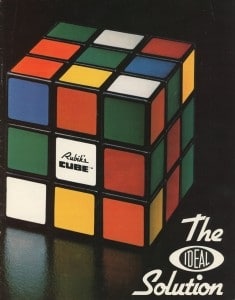
The cube's big break came in 1979 when a Hungarian businessman, Tibor Laczi, took it to the Nuremberg Toy Fair in Germany. There, it caught the eye of toy specialist Tom Kremer, who saw its immense potential. Kremer struck a deal with the Ideal Toy Company to market the puzzle worldwide. However, Ideal Toy Company wasn't fond of the name "Magic Cube," and in 1980, it was rebranded with a name that would become synonymous with a generation of puzzle-solvers: the Rubik's Cube.
The 1980s: A World in Color
The international debut of the Rubik's Cube in 1980 was a sensation. It quickly became a global phenomenon, with an estimated 200 million cubes sold between 1980 and 1983 alone. The cube's popularity was fueled by a massive television advertising campaign and its recognition with "Toy of the Year" awards in the UK, France, the US, and Germany.
The Rubik's Cube was so popular in the early 1980s that, at one point, three of the top ten best-selling books in the US were guides on how to solve it. The best-selling book of 1981 was "The Simple Solution to Rubik's Cube" by James G. Nourse, which sold over 6 million copies.
This period, often referred to as the "Cube Craze," saw the colorful puzzle become a fixture in homes, schools, and offices around the world. It was a challenge that was both maddeningly difficult and deeply satisfying to solve, appealing to a wide range of people.
Quick Facts
- Inventor: Ernő Rubik, a Hungarian sculptor and professor of architecture.
- Year Invented: 1974.
- Original Name: Bűvös Kocka (Magic Cube).
- Number of Possible Configurations: Over 43 quintillion (43,252,003,274,489,856,000).
- Units Sold Worldwide: Around 500 million as of January 2024, making it the world's best-selling toy.
The Psychology Behind the Puzzle
What made the Rubik's Cube so captivating? Its appeal lies in its deceptive simplicity. At first glance, it appears to be a straightforward toy. However, the sheer number of possible permutations—over 43 quintillion—makes solving it a significant challenge. This blend of simplicity in design and immense complexity in solution is a key part of its enduring charm.
Solving the Rubik's Cube provides a powerful sense of accomplishment. It's a tangible representation of overcoming a difficult problem, boosting self-confidence and a sense of achievement. The process of learning the algorithms and patterns required to solve the cube also has numerous cognitive benefits:
- Enhances Spatial Awareness: Manipulating the 3D object improves a user's ability to visualize and understand spatial relationships.
- Develops Logical and Algorithmic Thinking: Solving the cube requires a step-by-step process and the application of specific sequences of moves, which strengthens logical reasoning.
- Improves Memory and Concentration: Memorizing the various algorithms needed to solve the cube is a great mental workout.
- Fosters Perseverance and Resilience: The initial difficulty of the cube teaches the value of persistence and a growth mindset.
More Than a Toy: A Cultural Icon
The Rubik's Cube's influence extends far beyond the realm of toys and puzzles. It has become a powerful symbol in popular culture, representing intelligence, complexity, and the 1980s. Its presence can be seen across various media:

In Film and Television
The cube has been used in numerous films and TV shows, often as a shorthand to demonstrate a character's intelligence or problem-solving abilities. Notable appearances include "The Pursuit of Happyness," "The Big Bang Theory," and "Rick and Morty."
In Art
The Rubik's Cube has inspired a unique art movement known as "Rubikubism." Artists use multiple cubes to create intricate mosaics and portraits, showcasing the cube's aesthetic appeal beyond its function as a puzzle.
In Music
The cube has also made appearances in music videos and song lyrics, often as a metaphor for life's complexities. It has been featured in videos for songs like "Viva Forever" by the Spice Girls.
The Rise of Speedcubing
While the initial craze of the 1980s eventually subsided, the Rubik's Cube found a new and dedicated following in the world of competitive speedcubing. The first Rubik's Cube World Championship was held in Budapest in 1982, with the winner solving the cube in just under 23 seconds.
The advent of the internet in the late 1990s and early 2000s allowed a new generation of "cubers" to connect, share solving methods, and organize competitions. This led to the formation of the World Cube Association (WCA) in 2004, which governs official competitions and recognizes world records. Today, the speedcubing community is a thriving global phenomenon, with competitors constantly pushing the boundaries of human speed and dexterity. The current world record for a single solve of a 3x3x3 cube is a mind-boggling 3.13 seconds.
A Lasting Legacy
From its humble beginnings as a teaching aid in a Hungarian classroom, the Rubik's Cube has evolved into a global cultural touchstone. Its journey to becoming the world's best-selling toy is a testament to its ingenious design and the universal human desire for a challenge. It has captivated generations with its colorful complexity, teaching us about problem-solving, perseverance, and the satisfaction of bringing order to chaos.
The Rubik's Cube is more than just a toy; it is a testament to the power of a simple, yet brilliant, idea to capture the imagination of the world. It has secured its place in history not just on toy shelves, but in the annals of pop culture and as a beloved tool for cognitive development. The little cube that Ernő Rubik struggled to solve has indeed solved the puzzle of enduring global appeal.