

Surprising Facts About Space That Sound Like Science Fiction
The universe is a pretty wild place. We like to think we have a decent handle on things here on our little blue marble, but the moment you peek beyond our atmosphere, the rules we take for granted get twisted into mind-bending, logic-defying realities. We're talking about facts so strange, so utterly unbelievable, they sound like they were ripped straight from the pages of a classic science fiction novel.
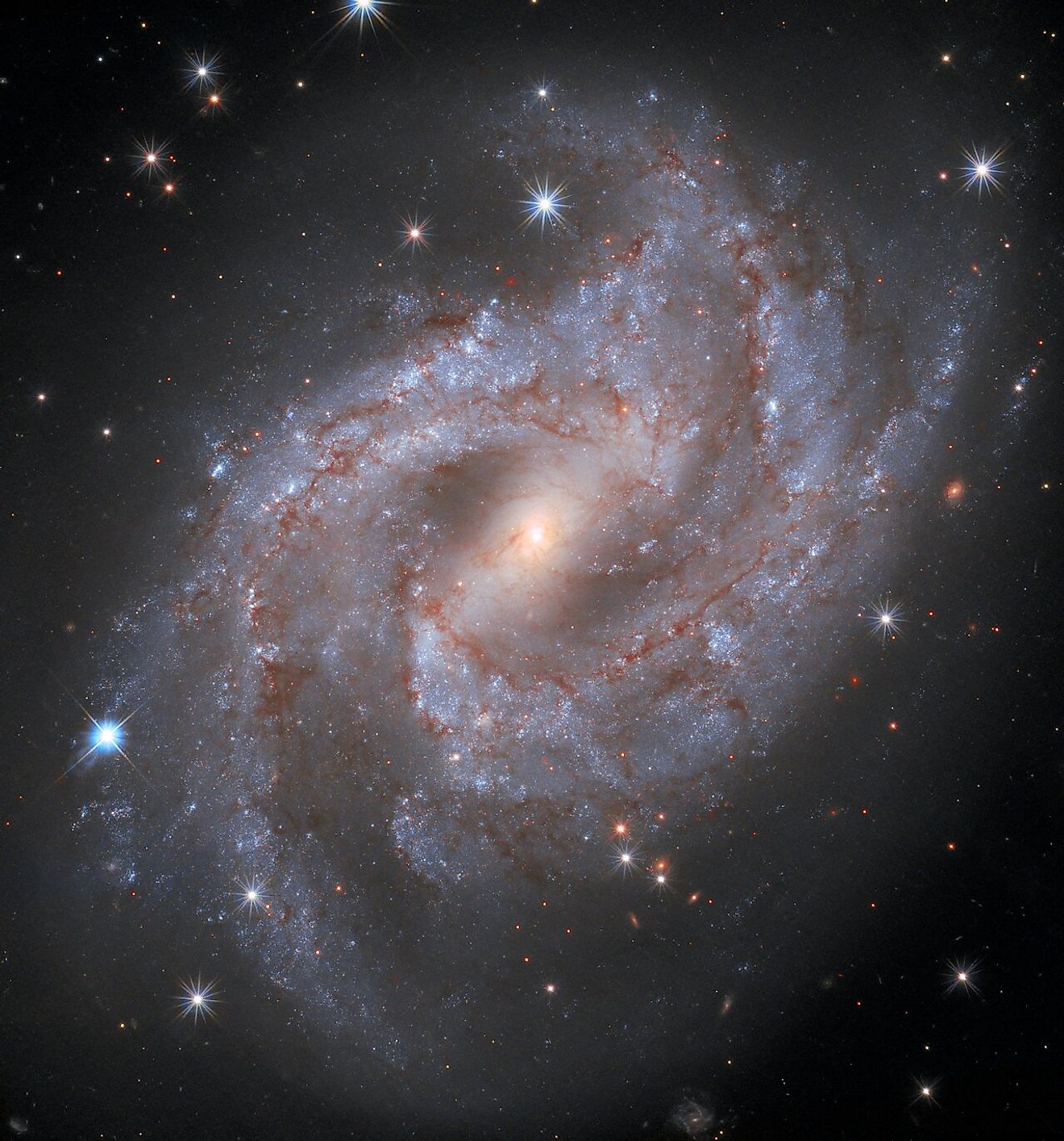
Forget what you think you know. We're about to embark on a journey through the cosmos where it rains glass sideways, diamonds are the size of planets, and celestial objects get ejected from their homes at unimaginable speeds. Buckle up, because the universe is weirder and more wonderful than you could ever imagine.
The Great Attractor: A Cosmic Mystery Pulling Us In
Imagine a colossal, unseen force in the universe, a gravitational anomaly so massive it's pulling our entire Milky Way galaxy, along with hundreds of thousands of other galaxies, towards it. This isn't the plot of a blockbuster movie; it's a very real phenomenon known as the Great Attractor.
First identified in the 1970s, the Great Attractor is a concentration of mass millions of times more massive than our own galaxy. It exerts an immense gravitational pull, causing a massive flow of galaxies across hundreds of millions of light-years. For decades, astronomers were puzzled by this motion, as the galaxies in our cosmic neighborhood all seemed to be heading in the same direction, suggesting a single, powerful source of gravity.
Hiding in Plain Sight
So, why can't we just point our telescopes at this cosmic behemoth and see what it is? The problem lies in its location. The Great Attractor is situated behind the plane of the Milky Way, in a region called the "Zone of Avoidance." This area is so dense with gas, dust, and stars from our own galaxy that it effectively blocks our view, making observations in the visible light spectrum incredibly difficult.
To peer through this cosmic curtain, astronomers have to rely on other wavelengths of light, like X-rays and infrared, which can penetrate the dust and gas. These studies have revealed a supercluster of galaxies, known as the Norma Cluster, residing in the area of the Great Attractor. However, the mass of this cluster alone isn't enough to explain the immense gravitational pull. The leading theory is that the Great Attractor is the central gravitational point of the Laniakea Supercluster, a colossal structure that contains our own Milky Way.
Planets of Unimaginable Wealth: The Diamond World
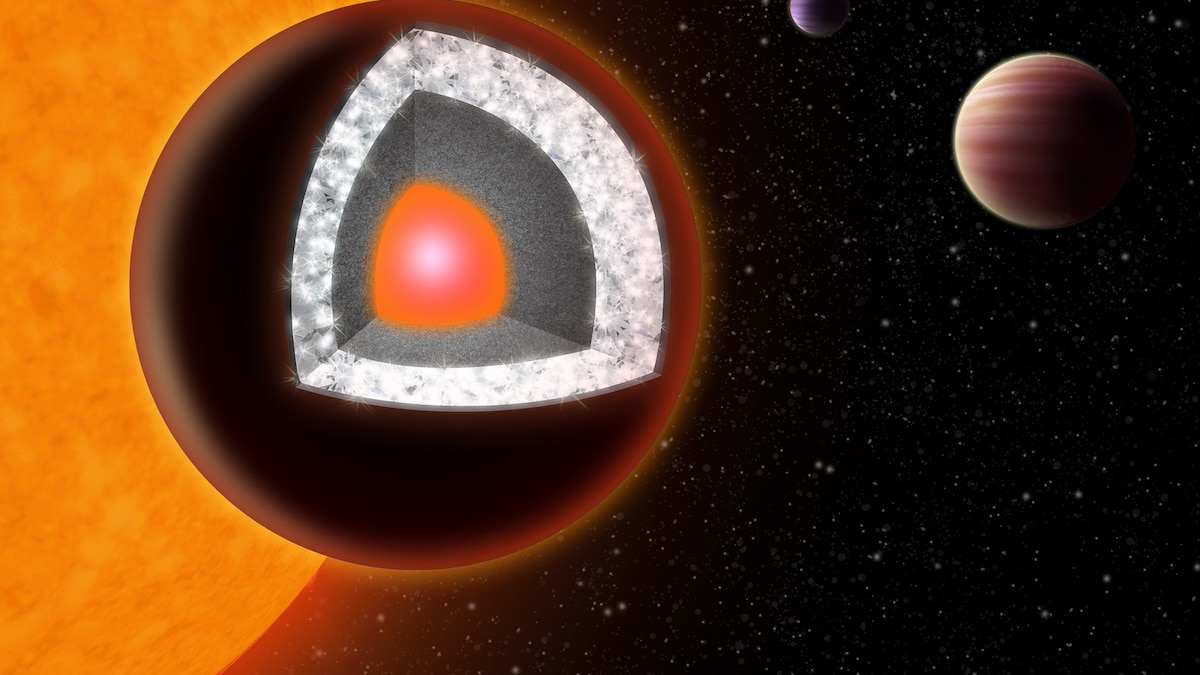
Forget earthly treasures; the cosmos has riches that defy our wildest dreams. Imagine a planet where the surface isn't made of rock and soil, but of graphite and shimmering diamonds. Welcome to 55 Cancri e, a "super-Earth" located about 40 light-years away that has captured the imagination of astronomers and science fiction fans alike.

Discovered in 2004, 55 Cancri e is about twice the size of Earth but has eight times its mass. It orbits its sun-like star at an incredible speed, with a year lasting a mere 18 hours. This close proximity to its star results in scorching surface temperatures of around 3,900 degrees Fahrenheit (2,150 degrees Celsius).
A Glimpse into an Alien Chemistry
What makes 55 Cancri e so fascinating is its chemical composition. Early observations suggested that its host star had more carbon than oxygen. This led scientists to theorize that the planet itself could be carbon-rich. In 2012, researchers at Yale University published a study suggesting that at least a third of the planet's mass could be diamond.
"This is our first glimpse of a rocky world with a fundamentally different chemistry from Earth," said Dr. Nikku Madhusudhan, the lead author of the study. "The surface of this planet is likely covered in graphite and diamond rather than water and granite."
While later studies have cast some doubt on the "diamond planet" hypothesis, suggesting the host star's carbon-to-oxygen ratio might not be as high as initially thought, the possibility of such an exotic world remains a tantalizing prospect. It challenges our assumptions about planetary formation and the diversity of worlds that could exist in our galaxy.
Quick Facts
- The Hercules-Corona Borealis Great Wall is the largest known structure in the universe, stretching an estimated 10 billion light-years across.
- Hypervelocity stars can travel at speeds of up to 1.5 million miles per hour (430 miles per second).
- There may be trillions of "rogue planets" wandering through the Milky Way, untethered to any star.
- In 2011, scientists discovered a cloud of water vapor in space containing 140 trillion times the amount of water in Earth's oceans.
Cosmic Vagabonds: Rogue Planets Wandering the Darkness
We're accustomed to the orderly dance of planets orbiting a central star. But what if a planet had no sun to call its own? What if it was cast out into the vast, lonely darkness of interstellar space, destined to wander for eternity? These are not hypothetical questions; they describe the reality of rogue planets.
These "free-floating" or "nomad" planets are worlds that have been ejected from their original solar systems. The first signs of these cosmic orphans were detected in 2000, and since then, our understanding of their prevalence has grown dramatically.
How a Planet Goes Rogue
There are a couple of primary ways a planet can end up on its own:
- Gravitational Ejection: In the chaotic early days of a solar system's formation, gravitational interactions between large planets can fling smaller worlds out of orbit.
- Stellar Flybys: A passing star can disrupt a planetary system, its gravitational influence pulling a planet away from its parent star.
- Star-like Formation: Some rogue planets might form on their own, collapsing from clouds of gas and dust much like stars do, but without ever igniting.
Detecting these dark, cold worlds is incredibly challenging since they don't emit their own light. Astronomers typically find them using a technique called gravitational microlensing, where the rogue planet's gravity briefly magnifies the light from a more distant star as it passes in front. Some estimates suggest there could be trillions of these rogue planets in our Milky Way galaxy alone, potentially outnumbering stars.
Hypervelocity Stars: Ejected from the Galactic Heart
It's not just planets that get kicked out of their homes. Imagine a star, a massive ball of burning gas, being launched from the center of our galaxy at such an incredible speed that it escapes the Milky Way's gravitational pull entirely. These are hypervelocity stars, some of the fastest objects in the universe.

These stellar exiles travel at astonishing speeds, sometimes exceeding 1.5 million miles per hour (or 430 miles per second). At that velocity, they are destined to journey through the vast emptiness of intergalactic space forever.
The Black Hole Slingshot
What could possibly launch a star with such force? The prime suspect is the supermassive black hole at the center of our galaxy, Sagittarius A*. The most widely accepted theory, proposed by J.G. Hills in 1988, involves a binary star system (two stars orbiting each other) getting too close to the black hole.
As the binary pair is pulled in by the black hole's immense gravity, one of the stars can be captured into a tight orbit around the black hole, while the other is violently ejected with incredible force. This gravitational "slingshot" sends the star hurtling out of the galaxy. The first of these stellar speedsters was discovered by surprise in 2005 by Warren Brown at the Smithsonian Astrophysical Observatory.
The Universe's Grand Design: Filaments and Voids
When you look up at the night sky, space can seem like a random scattering of stars. But when you zoom out—way out—a stunning and unexpected structure emerges. On the largest scales, the universe isn't random at all. It's organized into a vast, intricate network of filaments and voids known as the cosmic web.
Galaxies and galaxy clusters are not distributed evenly. Instead, they are arranged in massive, thread-like structures called galaxy filaments. These are the largest known structures in the universe, stretching for hundreds of millions, and in some cases billions, of light-years. These filaments are like colossal cosmic highways, and at their intersections, you find massive superclusters of galaxies.
The Largest Structures Known
Some of these structures are so vast they challenge our understanding of how the universe evolved. For instance:
- The Hercules-Corona Borealis Great Wall: Discovered in 2014, this is currently considered the largest known structure in the universe. It's an enormous filament of galaxies spanning an incredible 10 billion light-years. That's more than 10% of the diameter of the entire observable universe.
- The Sloan Great Wall: Discovered in 2003, this structure is a galaxy filament about 1.4 billion light-years in length.
- The South Pole Wall: A more recent discovery, this massive wall curves around our local supercluster and stretches for at least 1.4 billion light-years.
Between these massive filaments are enormous, nearly empty regions of space called voids. These cosmic deserts can be hundreds of millions of light-years across and contain very few galaxies. This grand, web-like structure is a result of gravity acting on tiny fluctuations in the density of matter in the early universe.
Whispers from the Void: The Sound of a Black Hole
The classic sci-fi tagline "In space, no one can hear you scream" is, for the most part, true. Sound requires a medium to travel, and the vacuum of space is not a friendly environment for sound waves. However, this idea comes with a fascinating and eerie exception: black holes.
In 2003, astronomers studying the Perseus galaxy cluster, about 250 million light-years away, made a startling discovery. The supermassive black hole at the cluster's center was sending out pressure waves through the hot gas that fills the cluster. These waves are, in essence, sound waves, just at a frequency far too low for humans to hear.
NASA took this data and "sonified" it, transposing the signals up 57 and 58 octaves to make them audible. The result is a haunting, deep groaning sound—the actual "voice" of a supermassive black hole.
This isn't just a novelty. These sound waves carry a tremendous amount of energy and play a crucial role in regulating star formation within the galaxy cluster. They distribute heat throughout the gas, preventing it from cooling and collapsing to form new stars at too high a rate.
Conclusion: The Fiction of Today, The Science of Tomorrow
From colossal, invisible forces pulling us across the universe to planets made of diamond and stars flung into the void, the realities of our cosmos are often more fantastic than anything we could invent. These discoveries remind us that the universe is not a static, predictable place. It is dynamic, mysterious, and filled with wonders that are constantly pushing the boundaries of our knowledge and imagination.
The next time you gaze up at the night sky, remember that you're not just looking at twinkling lights. You're looking at a stage where the most incredible science fiction stories are playing out for real. The line between what is possible and what is purely imaginative is constantly being redrawn, and who knows what other "fictional" truths are waiting to be discovered in the depths of space.