

The Deep Sea Creatures That Defy Imagination
A Realm Beyond the Sun: Journey into the World of Deep Sea Creatures
Imagine a world of crushing pressure, freezing temperatures, and eternal darkness. A place where sunlight has never reached, and the rules of life as we know them are completely rewritten. This isn't a distant planet; it's the deep sea, the largest and most mysterious habitat on Earth. For centuries, humanity could only speculate about what lurked in these abyssal depths. Today, thanks to incredible technology, we're finally pulling back the curtain on a world populated by creatures so bizarre, so alien, they truly defy imagination.
Forget everything you think you know about life on Earth. The animals that call the deep sea home have evolved in ways that are both beautiful and terrifying. They've conquered conditions that would instantly kill a human, developing a dazzling array of adaptations to survive in the crushing blackness. Get ready to meet the real-life monsters and marvels of the deep.
Living Light: The Magic of Bioluminescence
In a world without sun, many creatures have learned to create their own light. This phenomenon, known as bioluminescence, is not just for show; it's a critical tool for survival in the deep sea's perpetual night. From attracting prey to scaring off predators, this living light serves a multitude of purposes.

The Alluring Anglerfish
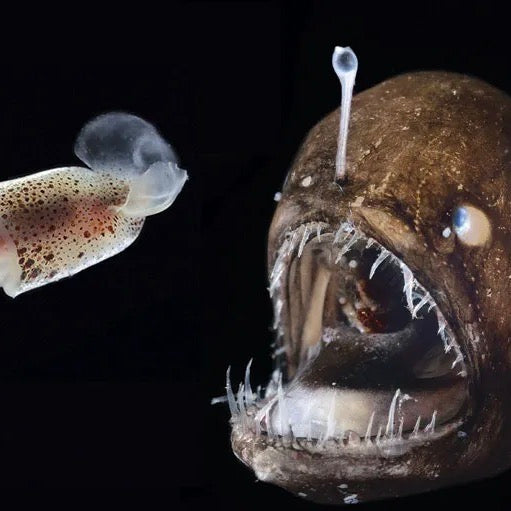
Perhaps no creature better exemplifies the "lure and devour" strategy than the deep-sea anglerfish. These ferocious-looking fish are famous for the fishing rod-like appendage that grows from their snouts. At the tip of this rod is a small organ packed with millions of light-producing bacteria, creating a glowing blob of light that dangles temptingly just above the anglerfish's massive, tooth-filled mouth. Unsuspecting prey, drawn to the curious light in the darkness, swim in for a closer look, only to be snatched up in an instant.
But the anglerfish's strangeness doesn't end there. Their mating habits are among the most bizarre in the animal kingdom. The males are tiny in comparison to the females—sometimes up to 60 times smaller. A male's sole purpose is to find a female in the vast darkness. Once he does, he bites onto her and permanently fuses his body to hers. His body then withers away, losing its eyes and most internal organs until he is little more than a pair of testes that provide sperm on demand. This extreme adaptation, known as sexual parasitism, ensures that reproduction is possible in the sparse and lonely deep-sea environment.
The Vampire Squid's Light Show
Don't let the name fool you; the Vampire Squid, or Vampyroteuthis infernalis (literally "vampire squid from Hell"), is not a bloodsucker. This small, deep-sea cephalopod gets its name from its dark, reddish-black color and the cape-like webbing that connects its eight arms. When threatened, it can pull this webbing over its body, turning itself inside out and exposing fleshy, spine-like projections called cirri.
The Vampire Squid is a master of bioluminescent defense. Its body is covered in light-producing organs called photophores, which it can flash to disorient predators. If truly startled, it can eject a sticky cloud of bioluminescent mucus from its arm tips. This glowing cloud can persist for up to 10 minutes, creating a dazzling distraction that allows the squid to escape into the darkness.
Quick Facts
- The pressure at the deepest point in the ocean, the Mariana Trench, is over 1,000 times that at sea level.
- Bioluminescence is the primary source of light in the deep sea, below about 200 meters.
- The Vampire Squid has the largest eyes relative to its body size of any animal in the world.
- Some deep-sea creatures, like the blobfish, have gelatinous bodies with minimal bone structure to withstand the immense pressure.
- The Goblin Shark can live for up to 60 years and has been around for about 125 million years, earning it the nickname "living fossil".
Giants of the Abyss: The Phenomenon of Deep-Sea Gigantism
While some deep-sea creatures are small and unassuming, others grow to truly monstrous proportions. This tendency for deep-sea animals to be larger than their shallow-water relatives is known as deep-sea gigantism. Scientists believe several factors contribute to this phenomenon, including the cold temperatures which slow metabolism and lead to longer lifespans and continued growth, as well as the scarcity of food which favors larger bodies capable of traveling further and consuming large, infrequent meals.
The Elusive Giant and Colossal Squids
For centuries, tales of giant sea serpents and krakens haunted sailors' dreams. These legends were likely inspired by real-life encounters with the Giant Squid (Architeuthis dux) and the even larger Colossal Squid (Mesonychoteuthis hamiltoni). The Colossal Squid, found in the frigid waters around Antarctica, is believed to be the largest invertebrate on Earth, potentially reaching lengths of up to 14 meters (46 feet). It possesses the largest eyes in the animal kingdom—bigger than dinner plates—and its arms are equipped with sharp, swiveling hooks.
The Prehistoric-Looking Giant Isopod
Imagine a common woodlouse or pill bug, but magnified to the size of a football. That's a Giant Isopod (Bathynomus giganteus). These armored scavengers scuttle along the seafloor of the Atlantic, Pacific, and Indian Oceans, feeding on whatever carcasses rain down from above. Their large size allows them to go for incredibly long periods without food; in captivity, one was observed to survive for five years without eating.
Built for Pressure: Surviving the Squeeze
Life in the deep sea is defined by one overwhelming physical force: pressure. At depths of 4,000 meters, the pressure is enormous, enough to crush a styrofoam cup to a fraction of its original size. To survive, deep-sea creatures have evolved bodies that are radically different from those of surface dwellers. Many have soft, gelatinous bodies with minimal skeletons, composed mostly of cartilage, which are more resistant to crushing than rigid bones.

The Misunderstood Blobfish
The blobfish (Psychrolutes marcidus) was famously voted the "World's Ugliest Animal" in 2013, but this title is deeply unfair. The sad, droopy, gelatinous blob we see in photos is the result of extreme tissue damage caused by being rapidly brought up from the immense pressure of its natural habitat. In its home, thousands of feet deep off the coast of Australia, the water pressure provides its body with structural support, and it looks much more like a typical fish.
The blobfish lacks a swim bladder, a gas-filled sac that most fish use to control buoyancy. Such a structure would collapse under the intense pressure. Instead, its body is made of a jelly-like mass that is slightly less dense than water, allowing it to float effortlessly just above the seafloor, conserving energy as it waits for small crustaceans and other edible matter to drift by.
The Living Fossils and Otherworldly Aliens
The deep sea is a refuge for creatures that seem to be ripped from the pages of a prehistoric textbook or a science fiction novel. Isolated in the dark for millions of years, these animals have evolved into forms that are both ancient and utterly alien.
The Goblin Shark's Slingshot Jaw
The Goblin Shark (Mitsukurina owstoni) is a true "living fossil," the only surviving member of a family that dates back 125 million years. This pink-skinned shark has a long, flattened snout that is covered in special sensing organs called ampullae of Lorenzini, which detect the faint electrical fields of its prey.
Its most terrifying feature is its jaw. A goblin shark can protrude its entire jaw forward, almost to the end of its snout, to snatch prey. This lightning-fast "slingshot" feeding mechanism is unmatched in the animal kingdom.
Despite its fearsome appearance and hunting method, the goblin shark is sluggish and poses no threat to humans, as it lives at depths far beyond our reach, typically between 800 and 3,000 feet.
The Adorable Dumbo Octopus
On the cuter end of the deep-sea spectrum is the Dumbo Octopus (genus Grimpoteuthis). Named for the prominent ear-like fins that protrude from the sides of its head, it gracefully "flies" through the water by flapping these fins. They are the deepest-living of all known octopuses, found at depths down to 7,000 meters (23,000 feet).
Life in such extreme depths means there are fewer predators, so the Dumbo Octopus has lost some of the classic octopus defense mechanisms. It lacks an ink sac, unable to cloud the water to cover an escape. It swallows its prey—like copepods, isopods, and bristle worms—whole.
Life Without the Sun: The World of Hydrothermal Vents
In 1977, scientists exploring the Galápagos Rift made a discovery that fundamentally changed our understanding of life on Earth. They found bustling ecosystems thriving in total darkness around hydrothermal vents—underwater geysers spewing superheated, mineral-rich water from beneath the Earth's crust.
Instead of sunlight, the base of the food chain here is chemosynthesis. Specialized bacteria harness chemical energy from the hydrogen sulfide in the vent fluids to create food. This process supports a dense community of bizarre creatures.
The Giant Tube Worms
Among the most iconic vent dwellers are the giant tube worms (Riftia pachyptila). These worms can grow up to 8 feet tall and have no mouth or stomach. They survive through a symbiotic relationship with billions of chemosynthetic bacteria living inside their bodies. The worms absorb chemicals from the vent water and deliver them to the bacteria, which in turn produce sugars that nourish the worm.
An Unexplored Universe on Our Own Planet
From the fish that fishes for its own dinner to the squid that defends itself with a cloud of light, the creatures of the deep sea are a testament to the boundless ingenuity of evolution. They have not just survived but thrived in an environment we once thought was entirely inhospitable to life. Each new dive and discovery reveals more about this hidden world, reminding us that some of the greatest mysteries and most unimaginable wonders are not in the stars, but right here on Earth, in the crushing, silent, and beautiful darkness of the deep ocean.