

The Most Prophetic Predictions That Actually Came True
Glimpses of Tomorrow: When Unbelievable Predictions Became Reality
Have you ever had a moment of déjà vu so strong it felt like you were remembering the future? Humanity has always been captivated by what lies ahead, from ancient oracles reading entrails to modern futurists analyzing data trends. While most predictions fade into obscurity, a select few have, against all odds, hit the mark with such startling accuracy that they defy simple explanation. These aren't just lucky guesses; they are detailed, specific, and often made decades or even centuries before the events they describe.

From Renaissance artists sketching out modern technology to science fiction authors penning the blueprints for real-life space missions, history is dotted with these uncanny moments of foresight. Are they mere coincidence, the product of profound intuition, or something more? Let's journey through time and uncover some of the most prophetic predictions that actually came true, leaving skeptics and believers alike in stunned silence.
The Renaissance Man Who Saw the Future: Leonardo da Vinci
Long before he was famous for painting the Mona Lisa, Leonardo da Vinci filled his notebooks with more than just anatomical sketches and artistic studies. He was an obsessive inventor and conceptual thinker, and his writings contain what can only be described as prophecies of a world centuries beyond his own. Though framed as riddles, their meaning today is chillingly clear.
Da Vinci wasn't just dreaming; he was conceptually inventing. His notebooks from the late 15th and early 16th centuries are filled with designs that were precursors to modern technology. He designed an armored fighting vehicle, essentially a precursor to the modern tank, propelled by men turning crankshafts. He also sketched a "33-barreled organ," a multi-shot weapon designed to solve the slow-loading time of cannons, which is considered a basis for the machine gun.
Visions of Flight and Beyond
Perhaps most famously, Leonardo was obsessed with flight. He designed numerous "flying machines," including a parachute and a device remarkably similar to a helicopter. A note accompanying one parachute sketch from around 1485 reads, "If a man has a structure made out of coated cloth 12 arms wide and 12 tall, he will be able to throw himself from any great height without hurting himself." While he never built these himself, his understanding of physics and mechanics was profoundly ahead of its time.
"Men shall speak with each other from the most remote countries, and shall answer each other." - Leonardo da Vinci, predicting telephones and the internet.
His predictions extended beyond warfare and flight. He conceptualized a form of solar power, suggesting that mirrors could be used to concentrate sunlight to heat water. He even imagined a "cooling machine" that operated with bellows and leather chambers, a primitive but clear concept of a refrigerator. These weren't just wild guesses; they were the logical conclusions of a mind that saw the boundless potential of science and engineering.
The Seer of Salon: Nostradamus and His Cryptic Quatrains
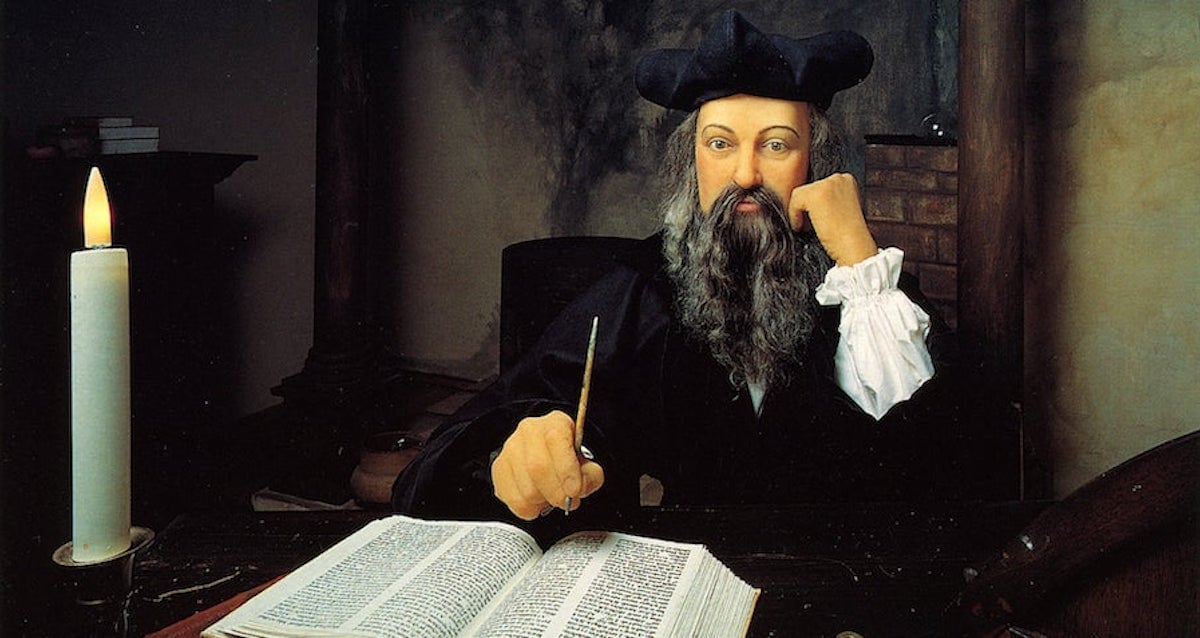
No discussion of prophecy is complete without mentioning Michel de Nostredame, the 16th-century French astrologer and physician better known as Nostradamus. His 1555 book, Les Prophéties, a collection of poetic four-lined verses called quatrains, has been scrutinized for centuries for its supposed predictions of major world events.
Interpreting Nostradamus is notoriously difficult. His verses are vague, filled with metaphors, and written in a mix of French, Latin, Greek, and Occitan. Skeptics argue that their ambiguity allows them to be retrofitted to almost any event. Yet, some of his passages are so specific that they continue to raise eyebrows.
From London's Fire to a German Dictator
One of the most cited examples is his apparent prediction of the Great Fire of London in 1666.
"The blood of the just will commit a fault at London, / Burnt through lightning of twenty threes the six: / The ancient Lady will fall from her high place, / Several of the same sect will be killed."
Interpreters point to "twenty threes the six" (20 x 3 + 6) as equaling 66, pinpointing the year. The fire, which started in a bakery, devastated the city. Another famous quatrain is believed to predict the rise of Adolf Hitler.
Nostradamus wrote of a figure named "Hister" and stated, "From the depths of the West of Europe, / A young child will be born of poor people, / He who by his tongue will seduce a great troop." Hitler, an Austrian born to a poor family, was a powerful orator. Furthermore, "Hister" is an old name for the Danube River, near where Hitler was born.
He is also credited with foreseeing the death of King Henry II of France in 1559, who died in a jousting accident when a splinter from his opponent's lance pierced his eye and brain through his helmet. Nostradamus wrote: "The young lion will overcome the older one, / On the field of combat in a single battle; / He will pierce his eyes through a golden cage, / Two wounds made one, then he dies a cruel death."
The Wizard of Wardenclyffe: Nikola Tesla's Technological Foresight
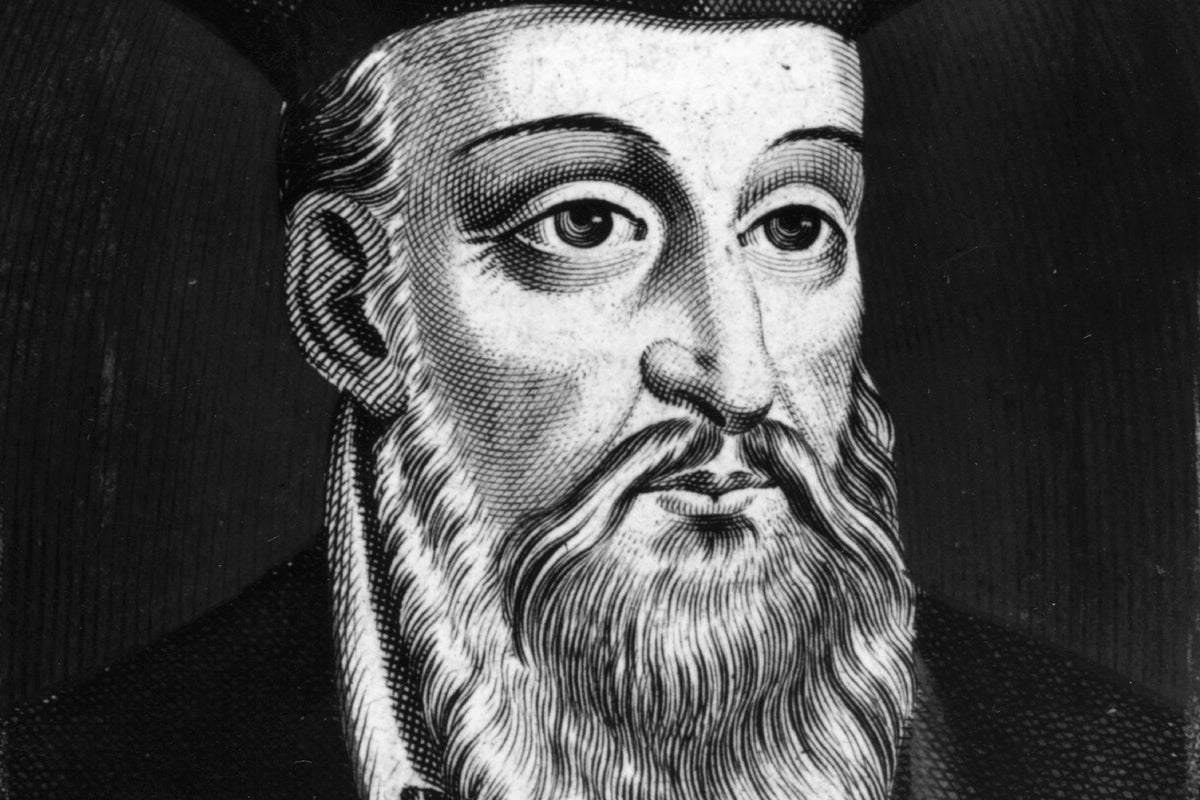
Not all prophets gaze into crystal balls; some simply understand the trajectory of science better than anyone else. Nikola Tesla, the brilliant and eccentric inventor, was one such scientific seer. In the late 19th and early 20th centuries, he described a future that sounds remarkably like our present-day connected world.
A "World System" of Wireless Communication
Decades before the digital revolution, Tesla envisioned a global wireless system that would transmit information and energy. In a 1926 interview with Collier's magazine, he didn't just predict mobile phones; he described the smartphone with startling clarity.
"When wireless is perfectly applied the whole earth will be converted into a huge brain... We shall be able to communicate with one another instantly, irrespective of distance. Not only this, but through television and telephony we shall see and hear one another as perfectly as though we were face to face... and the instruments through which we shall be able to do this will be amazingly simple in comparison with our present telephone. A man will be able to carry one in his vest pocket."
This single prediction encapsulates the internet, Wi-Fi, and smartphones. He saw a future where news, media, and all forms of data were delivered wirelessly. His vision was so complete that he began building the Wardenclyffe Tower in 1901, intending it to be the first hub in this global network before funding was pulled.
Tesla's foresight didn't stop there. In 1898, he demonstrated a radio-controlled boat at Madison Square Garden, an invention he called a "teleautomaton." This laid the conceptual groundwork for everything from TV remotes to modern military drones.
Quick Facts
- Many of H.G. Wells' predictions were rooted in science. His 1914 novel, The World Set Free, described "atomic bombs" and nuclear warfare over 30 years before the Manhattan Project. Physicist Leó Szilárd read the book in 1932 and was directly inspired by it to pursue the concept of a nuclear chain reaction.
- Mark Twain was born in 1835, shortly after an appearance of Halley's Comet. In 1909, he famously said, "I came in with Halley's Comet... It is coming again next year, and I expect to go out with it." He died of a heart attack on April 21, 1910, one day after the comet made its closest approach to the sun.
- In his 1953 novel Fahrenheit 451, Ray Bradbury described "seashells" and "thimble radios," which bear a striking resemblance to modern earbuds and Bluetooth headsets.
Literary Prophecies: When Fiction Foretells Fact
Sometimes, the most stunning prophecies come not from seers, but from storytellers. Science fiction, in particular, has a long history of imagining futures that later become reality. Authors, by exploring the logical progression of current technology and society, have occasionally penned tales that read like historical accounts written in advance.
Jules Verne's Moonshot Manual
In 1865, more than a century before the Apollo 11 mission, French author Jules Verne wrote From the Earth to the Moon. The novel's parallels to the actual moon landing are uncanny.
- Launch Location: Verne's spacecraft, the Columbiad, was launched from Florida, the same state as NASA's Kennedy Space Center. Verne chose Florida after calculating that launching near the equator would give the projectile an extra boost from the Earth's rotation—the same reason NASA chose the location.
- Crew Size: The Columbiad carried a crew of three, the same number as the Apollo command module.
- Return Trip: After their lunar journey, Verne's astronauts splashed down in the Pacific Ocean, just as the Apollo crews did.
- Vessel Name: The Apollo 11 command module was named Columbia, a striking echo of Verne's Columbiad.
The similarities were so numerous that the Apollo 11 crew even referenced Verne's book during their mission. It's a powerful example of how scientific principles, combined with imagination, can lead to remarkably accurate predictions.
The Wreck of the Titan: A Maritime Ghost Story
Perhaps one of the most chilling literary predictions is Morgan Robertson's 1898 novella, Futility, or the Wreck of the Titan. The book tells the story of a massive British ocean liner named the Titan, hailed as "unsinkable," which strikes an iceberg in the North Atlantic on a cold April night and sinks with immense loss of life due to an insufficient number of lifeboats.
Fourteen years later, in 1912, the RMS Titanic, a massive British ocean liner hailed as "unsinkable," struck an iceberg in the North Atlantic on a cold April night and sank with immense loss of life due to an insufficient number of lifeboats. The parallels are astounding:
- Name: Titan vs. Titanic.
- Size: The fictional Titan was 800 feet long; the Titanic was 882 feet long.
- "Unsinkable": Both ships were described with this fateful adjective and featured advanced safety features like automatically closing watertight compartments.
- The Incident: Both ships struck an iceberg on their starboard side around midnight in April in the North Atlantic.
- Lifeboats: Both ships carried only the legal minimum number of lifeboats, which was tragically inadequate for the number of passengers on board (the Titan had 24 for 3000 people, the Titanic had 20 for 2200+ people).
Robertson denied having any psychic abilities, attributing the similarities to his extensive knowledge of maritime trends and shipbuilding. Still, the story remains a haunting example of fiction becoming a horrifying reality.
Conclusion: Coincidence, Intuition, or Something More?
As we look back at these incredible predictions, we're left to wonder about their origins. Are they simply the result of the law of large numbers, where enough predictions are made that some are bound to come true? Or do they point to something deeper—a profound understanding of scientific principles, a keen intuition about the currents of history, or perhaps even a fleeting glimpse into the fabric of time itself?
From Leonardo's engineering mind and Tesla's scientific foresight to the imaginative leaps of Verne and Robertson and the cryptic verses of Nostradamus, these stories challenge our understanding of the possible. They remind us that the future is not always as unpredictable as it seems. Whether by logic, imagination, or a stroke of prophetic genius, these figures saw tomorrow, and in doing so, they left us with a tantalizing and eternal question: what else might be waiting just over the horizon, already seen by someone ahead of their time?