

The Surprising History of Popular Nursery Rhymes
They are the soundtracks to our earliest memories, sung to us in gentle lullabies and chanted in playgrounds. Nursery rhymes feel as innocent and timeless as childhood itself. But what if we told you that beneath the simple melodies and playful words lie tales of plague, political satire, religious persecution, and royal scandal? Prepare to see Mother Goose in a whole new light as we delve into the surprising, and often dark, history of our most beloved childhood verses.
From Idle Amusement to Enduring Lore: The Birth of the Nursery Rhyme
Before they were neatly printed in colorful books, nursery rhymes were part of a vibrant oral tradition. In societies where many people couldn't read, catchy, sing-song verses were the perfect way to pass stories and cultural memory from one generation to the next. These rhymes were not always intended for children; many originated as songs, ballads, proverbs, and even drinking songs for adults.
It wasn't until the mid-18th century that these rhymes began to be collected and published specifically for a young audience. Groundbreaking publications like Tommy Thumb's Pretty Song Book (1744) and John Newbery's Mother Goose's Melody (1781) gathered these traditional verses, forever associating them with the world of childhood. Yet, in this transition from the tavern to the nursery, the original contexts were often lost, leaving us with deceptively simple rhymes whose true origins are hotly debated by historians and folklorists.
Ring a-Round the Rosie: A Plague Song or a Playful Game?
Perhaps no nursery rhyme has a more famous—or more contested—dark history than "Ring a-Round the Rosie." The popular theory, which gained traction in the mid-20th century, is that the rhyme is a chilling allegory for the Great Plague of London in 1665. According to this interpretation, each line corresponds to a symptom or outcome of the bubonic plague.

Deconstructing the Plague Theory
- "Ring a-round the rosie" is said to describe the red, ring-shaped rash that was a tell-tale sign of the disease.
- "A pocket full of posies" supposedly refers to the small bouquets of flowers and herbs people carried to ward off the "bad air" or miasma they believed caused the plague, and to mask the constant smell of death.
- "Ashes, ashes" (or "A-tishoo, a-tishoo" in British versions) is linked to the sneezing fits that were a final symptom for many, or to the cremation of victims' bodies.
- "We all fall down" needs little explanation: it represents the swift and widespread death that ravaged Europe.
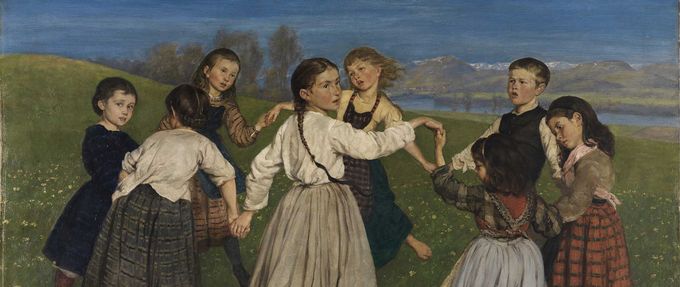
"Few people watching a group of children dancing hand-in-hand in a circle to this well-known nursery rhyme may realize that it has its origin in the plague." - James Leasor
However, modern folklorists pour cold water on this grim interpretation. They point out that the rhyme wasn't written down until the 1880s, long after the great plagues. Furthermore, the supposed plague "symptoms" mentioned in the rhyme are not entirely consistent with historical accounts. The more likely origin? It was probably a simple children's singing and dancing game, possibly created to cleverly get around Protestant bans on dancing in the 19th century. The dramatic "fall down" at the end was just a fun flourish for the kids.
Did You Know?
- The term "Mother Goose" was first linked to nursery rhymes in 1780 by publisher Thomas Carnan.
- Famed folklorists Iona and Peter Opie dedicated their lives to researching the origins of nursery rhymes, publishing the monumental The Oxford Dictionary of Nursery Rhymes.
- Many nursery rhymes share the same melody; "Twinkle, Twinkle, Little Star," "Baa, Baa, Black Sheep," and "The ABC Song" all use the same 18th-century French tune, "Ah! vous dirai-je, maman".
Of Queens and Taxes: Unpacking Political Allegories
Many seemingly innocent rhymes are believed to be clever, coded commentaries on political events and royal figures. In a time when openly criticizing the monarchy could land you in serious trouble, embedding satire in a simple ditty was a safer way to express dissent.
Mary, Mary, Quite Contrary
This rhyme, first published in 1744, is often linked to Queen Mary I of England, also known as "Bloody Mary." Her "contrary" nature is said to refer to her violent and ultimately unsuccessful attempt to reverse the Protestant Reformation and restore Catholicism in England.
The "garden" is interpreted as England itself, or sometimes the graveyards filling up with her executed subjects. The "silver bells and cockle shells" are not charming decorations, but alleged nicknames for instruments of torture used on Protestants. The "pretty maids all in a row" could be a grim reference to the lines of people waiting for the guillotine or other execution devices.
Baa, Baa, Black Sheep
While some 20th-century debates questioned if this rhyme had racial undertones, most scholars agree "Baa, Baa, Black Sheep" is about economics, not race. The rhyme, which first appeared in print around 1744, is widely believed to be a complaint about the heavy wool tax imposed by King Edward I in the 13th century.
The three bags of wool represent the division of profits from the valuable wool trade:
- "One for the master": Representing the King, who claimed a third.
- "One for the dame": Representing the Church, which also took a third.
- "One for the little boy who lives down the lane": In the original version, this line was reportedly "And none for the little boy who cries down the lane," signifying that the poor farmer or shepherd was left with nothing after the heavy taxes.
The mention of a "black sheep" may also be significant, as the wool from black sheep could not be dyed and was therefore less valuable to the farmer.
Jack and Jill
The tale of two children tumbling down a hill has several proposed political origins. One popular but chronologically flawed theory links it to France's King Louis XVI ("Jack") who was beheaded ("broke his crown"), followed by his wife, Marie Antoinette ("Jill came tumbling after"). The problem is, the rhyme was first written down decades before the French Revolution.
A more plausible theory connects it to King Charles I of England in the 17th century. He attempted to reform taxes on liquid measures, but Parliament rejected his proposal. To get around them, he ordered that the volume of a "Jack" (a half-pint) be reduced, but the tax remained the same. This meant that the tax revenue on a "gill" (a quarter-pint) also "came tumbling down."
Humpty Dumpty: An Egg, a King, or a Cannon?
We all picture Humpty Dumpty as a fragile, anthropomorphic egg. But nowhere in the rhyme is he actually described as one! The image comes from later illustrations, most famously by Lewis Carroll in Through the Looking-Glass. The rhyme itself is a riddle, and the answer is "an egg."

Humpty Dumpty sat on a wall,
Humpty Dumpty had a great fall.
All the king's horses and all the king's men
Couldn't put Humpty together again.
However, history suggests a more robust identity for our fallen hero. One compelling theory posits that "Humpty Dumpty" was not a person but a powerful piece of military hardware. During the English Civil War, a large cannon, colloquially nicknamed Humpty Dumpty, was mounted on a church wall in the Royalist-held city of Colchester in 1648.
When Parliamentary forces fired their own cannon, they damaged the wall beneath Humpty Dumpty, causing the massive cannon to tumble to the ground. It was so heavy and shattered that "all the king's men" were unable to repair or remount it, a significant blow to the city's defenses.
Another theory suggests Humpty is King Richard III, who was supposedly hunchbacked ("humpty") and was defeated at the Battle of Bosworth Field in 1485, despite the efforts of his army ("all the king's men").
More Rhymes with Hidden Histories
The list of rhymes with surprising backstories goes on and on. The familiar melodies we know today often mask tales of religious strife, social commentary, and historical events that were all too real for the people who first sang them.
Goosey Goosey Gander
This seemingly nonsensical rhyme about a wandering goose is thought to be a chilling tale of religious persecution during the 16th-century Protestant Reformation in England. Catholic priests, loyal to the Pope, had to hide in secret "priest holes" within the homes of Catholic families to say their Latin prayers, which was forbidden. The rhyme's original ending is quite brutal: "There I met an old man // Who wouldn't say his prayers // So I took him by his left leg // And threw him down the stairs."
Here We Go Round the Mulberry Bush
This classic playground singing game may have a less-than-cheerful origin. According to one historian and former prison governor, the song originated at Wakefield Prison in England. Female inmates would exercise with their children around a mulberry tree in the prison yard, inventing the song to keep the children occupied and pass the time.
A Legacy Written in Rhyme
So, the next time you hear "Rock-a-Bye Baby" (a possible commentary on the precarious line of succession to the English throne) or "London Bridge is Falling Down" (which could be about a Viking attack in 1014 or even human sacrifice), remember that you're not just hearing a simple children's song. You are hearing the faint echoes of history—of political intrigue, social hardship, and human resilience, all cleverly packaged in a memorable, musical format.
These rhymes have endured for centuries precisely because their meanings are layered and their melodies are infectious. They are a testament to the power of oral history and a fascinating window into the past, reminding us that even the most innocent-seeming traditions can have surprisingly deep and complex roots. The stories have been softened over time, but the history remains, locked away in the simple verses we've known our entire lives.