
63
Learn More
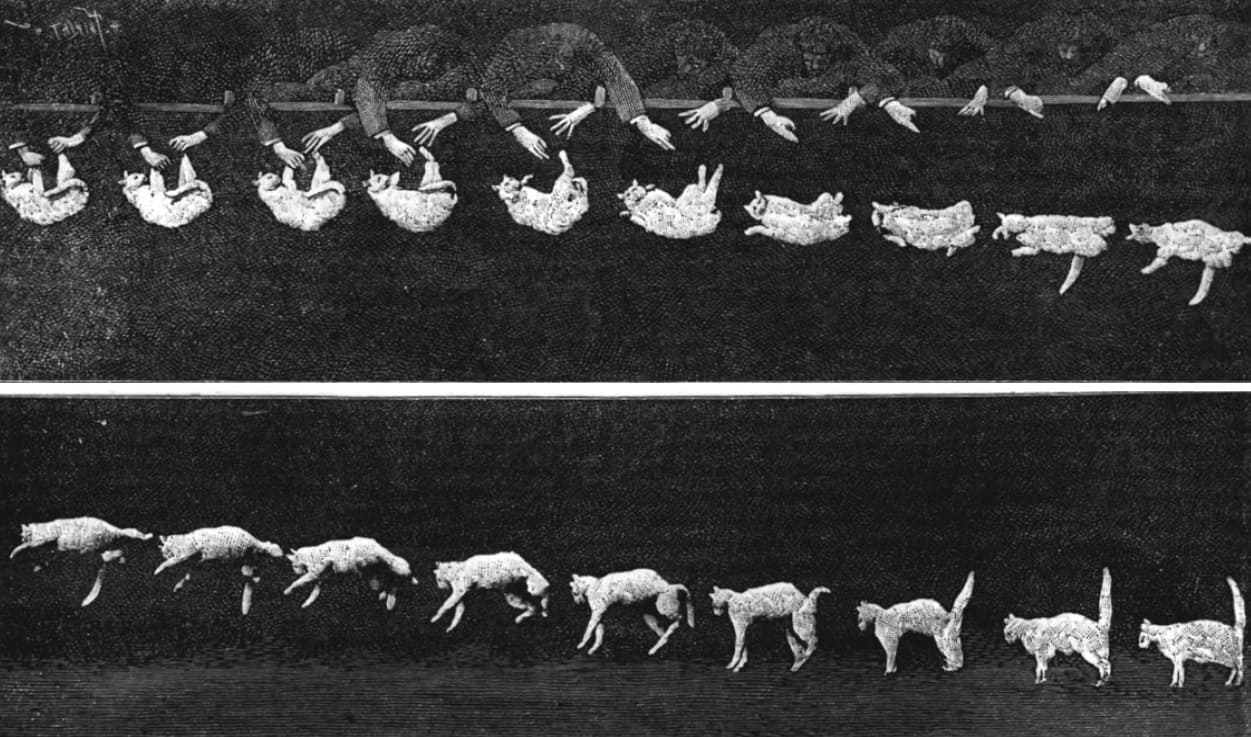
The widespread belief that a falling cat invariably lands on its feet has fascinated humans for centuries, leading to a common saying and even attributing supernatural agility to felines. This misconception likely stems from countless observations of cats demonstrating their impressive ability to reorient themselves mid-air after a tumble, a skill that appears almost magical. Historically, scientists even struggled to explain this phenomenon, with early theories incorrectly suggesting cats pushed off their perch or used air buoyancy to flip over.
The truth lies in an incredible biological adaptation known as the "righting reflex," an innate ability perfected in kittens by about six to nine weeks of age. Cats possess an exceptionally flexible backbone, featuring more vertebrae than humans, and a unique vestibular system in their inner ear that acts as a highly sensitive internal gyroscope. This allows them to instantly detect their body's orientation in space. As a cat falls, it uses its flexible spine to twist its front and back halves independently, adjusting its legs to control rotation and ensure its paws are pointed towards the ground.
While this reflex is remarkably effective, it is not foolproof. Cats do not always land on their feet, especially during very short falls (under roughly 12 inches) where they lack sufficient time to fully engage their reflex, or during unexpectedly angled tumbles. Furthermore, paradoxically, falls from intermediate heights (like two to six stories) can sometimes lead to more severe injuries than higher falls, as greater heights allow the cat more time to prepare for impact and spread its body to reduce velocity. Their muscular, angled legs then act as shock absorbers upon landing. The consistent demonstration of this complex maneuver is why people often believe the myth, even though there are exceptions.
Related Myths
84
84
84
84
84
84